
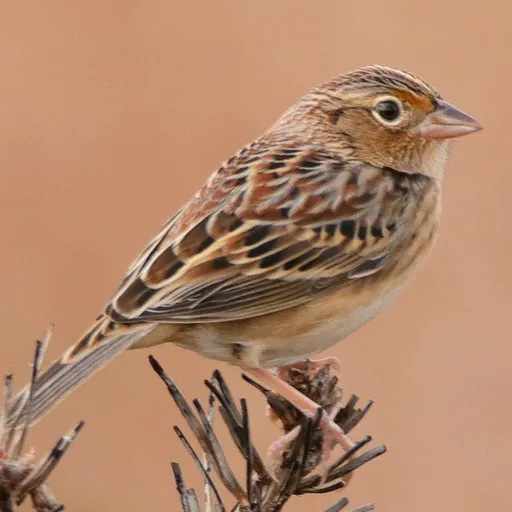
Grasshopper Sparrow
Ammodramus savannarum
Least Concern
Listen
XC550993 · Peter Wilton · Santa Teresa County Park (near San Jose), Santa Clara County, California, United States · CC BY-SA 4.0
Overview
The grasshopper sparrow (Ammodramus savannarum) is a small New World sparrow found in the genus Ammodramus, which contains three species inhabiting grasslands and prairies. It is currently classified as Least Concern by the IUCN Red List, although the species is in steep decline across its range and the Florida subspecies is highly endangered.
Identification
- Small size, measuring 10–14 cm in length with a wingspan of approximately 17.5 cm and weighing between 13.8 and 28.4 g.
- Upper parts are streaked with brown, grey, black, and white, while the face is light brown with a white eye ring and a dark brown crown featuring a central narrow light stripe.
- Adults possess bright yellow feathers at the crook of the underwing and a yellow-to-amber patch above the lores; males and females are indistinguishable by plumage.
- The primary song is a high trill preceded by short chips, resembling the sounds of grasshoppers, which is the origin of the species' name.
Habitat
The breeding habitat consists of open fields and prairie grasslands across southern Canada, the United States, Mexico, Central America, and the Caribbean, with a small endangered population in the Andes of Colombia and possibly Ecuador. In the core of their range, they are dependent upon large areas of grassland, avoiding trees and shrubs and seeking out heterogeneous patches with clumps of dead grass and barer ground for foraging. They are also found in crop fields and readily colonize reclaimed grassland.
Diet
Grasshopper sparrows forage on barer ground within their habitat, feeding on insects such as grasshoppers, spiders, and beetles, as well as seeds. Nestlings are fed an arthropod-rich diet, particularly prey 15–40 mm long, with a preference for acridid grasshoppers, spiders, and small beetles.
Did you know?
The Florida grasshopper sparrow (Ammodramus savannarum floridanus) is highly endangered and may be preyed upon by various invasive snake species, including Burmese pythons, reticulated pythons, and boas.
Sources
- Wikipedia · CC BY-SA 4.0
- Wikidata · CC0 1.0