
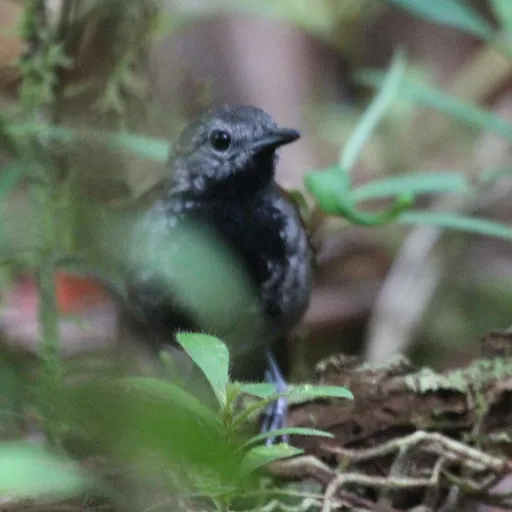
Grey-bellied Antbird
Ammonastes pelzelni
Least Concern
Overview
The grey-bellied antbird (Ammonastes pelzelni) is a passerine bird in the family Thamnophilidae, found in Brazil, Colombia, and Venezuela. It is a year-round resident and is assessed as being of Least Concern by the IUCN, with a population that is believed to be stable despite its specialized habitat requirements.
Identification
- Adult males feature a mottled whitish and gray face, a dark grayish-brown crown, and yellowish red-brown upperparts.
- The throat and breast are black with a gray border, transitioning to reddish yellow-brown on the rest of the underparts.
- Females have white upper breasts with a blackish scaly appearance and larger white spots on the wing coverts compared to males.
- Both sexes possess a black bill, pale brown legs, and measure 12.5 to 14 cm in length.
- The song consists of a level series of about 15 very high-pitched 'sree' notes, while the call is a short, high-pitched rattling trill that declines in intensity.
Habitat
The species has a disjunct distribution in the south-central Caquetá Department and far eastern Guainía and Vaupés departments of Colombia, southwestern Amazonas state in Venezuela, and extreme northwestern Amazonas state in Brazil. It primarily inhabits Amazonian caatinga forest and denser forest with bromeliads growing on white-sand soils, as well as the ecotone between caatinga and seasonally flooded igapó forest, found at elevations up to 400 m.
Diet
The grey-bellied antbird feeds on arthropods, particularly insects and spiders, foraging almost exclusively on the ground. It typically gleans prey from the surface of leaf litter or within curled dead leaves, and occasionally ascends slightly up fallen logs or branches to glean from moss or nearby leaves.
Did you know?
The genus name Ammonastes is derived from the Ancient Greek words for 'sand' and 'inhabitant', a direct reference to the bird's preference for vegetation growing on sandy soils.
Sources
- Wikipedia · CC BY-SA 4.0
- Wikidata · CC0 1.0