
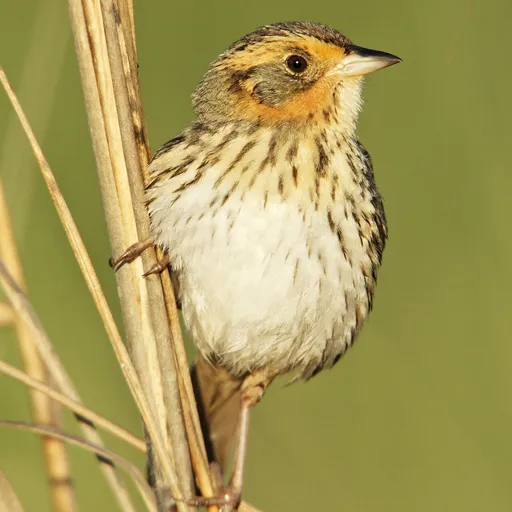
Saltmarsh Sparrow
Ammospiza caudacuta
Endangered
Overview
The saltmarsh sparrow (Ammospiza caudacuta) is a small New World sparrow that inhabits tidal salt marshes along the Atlantic coast of the United States. Once considered part of the sharp-tailed sparrow complex, it is now recognized as a distinct species and is classified as Endangered due to significant population declines.
Identification
- Measures 11–14 cm in length with a wingspan of 17.8–21 cm and a weight of 14–23.1 g.
- Adults display brownish upperparts, a gray nape, white throat and belly, and pale orange breast and sides with brown streaking.
- The face features orange coloration with gray cheeks, a gray median crown stripe, brown lateral crown stripes, and a brown eyeline.
- The song is a complex series of raspy, barely audible buzzes, trills, and gurgles, sung only by males.
Habitat
Found exclusively in tidal salt marshes along the Atlantic coast of the United States, the species breeds from Maine to the Chesapeake Bay and winters from North Carolina to Florida. It strongly prefers high marsh habitat dominated by saltmeadow cordgrass and saltmarsh rush, which experiences less frequent flooding than low marsh areas.
Diet
The saltmarsh sparrow forages on the ground along tidal channels or within marsh vegetation, occasionally probing mud at low tide. Over 80% of the nestling diet consists of flies, amphipods, grasshoppers, and moths, while adults consume seeds during the winter. As an opportunistic feeder, food availability is rarely limiting for the species.
Did you know?
To mitigate the high risk of nest loss from periodic spring tides, saltmarsh sparrows synchronise their breeding with the lunar cycle, timing nesting so that young fledge just before the next major flood. The species is also highly susceptible to mercury bioaccumulation, a threat distinct from its primary hazard of sea level rise.
Sources
- Wikipedia · CC BY-SA 4.0
- Wikidata · CC0 1.0