
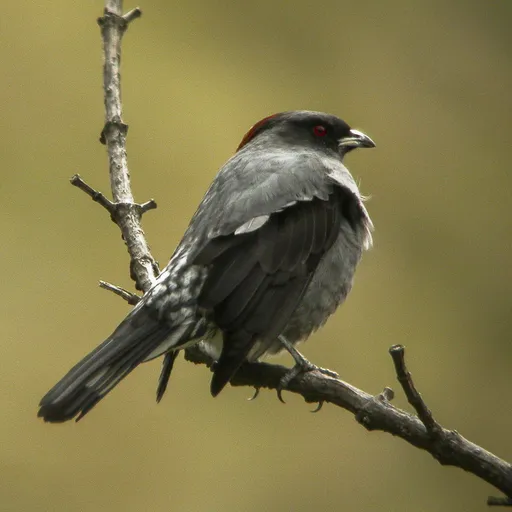
Red-crested Cotinga
Ampelion rubrocristatus
Least Concern
Listen
XC248606 · Niels Krabbe · Pichincha: Loma Yanayacu Polylepis forest, Volcán Pichincha, Ecuador · CC BY-SA 4.0
Overview
The red-crested cotinga (Ampelion rubrocristatus) is a monotypic species of bird in the family Cotingidae. It is currently assessed as Least Concern by the IUCN, although its population size is believed to be decreasing.
Identification
- A medium-sized bird measuring 20.5 to 22 cm in length and weighing 47 to 80 g, with identical plumage in both sexes.
- Features a dark gray head topped by a long chestnut-maroon crest that is usually held flat against the nape.
- The body is gray with darker wings and tail, while the rump and vent area show variable white streaking; the tail underside has a white band near the tip.
- Possesses a deep red iris, a bill with an ivory-white or pale gray base and blackish gray tip, and black or dark gray legs and feet.
Habitat
This species inhabits semi-open temperate landscapes, including cloudforest edges, humid woodlands, páramo with patches of vegetation, and the borders of agricultural areas with trees. It has a disjunct distribution across the Andes of Bolivia, Colombia, Ecuador, Peru, and Venezuela, typically occurring at elevations between 2,300 and 3,800 m.
Diet
The red-crested cotinga feeds mostly on fruits, occasionally supplementing its diet with insects. It forages singly, in pairs, or in small groups, usually plucking fruit with short sallies from a perch or capturing insects in mid-air.
Did you know?
Despite its avian nature, the species' vocalisations have been compared to amphibians, with its song described as a stuttered series of deep notes ending in a short croak and its calls as a deep, croaking, 'crek'.
Sources
- Wikipedia · CC BY-SA 4.0
- Wikidata · CC0 1.0