
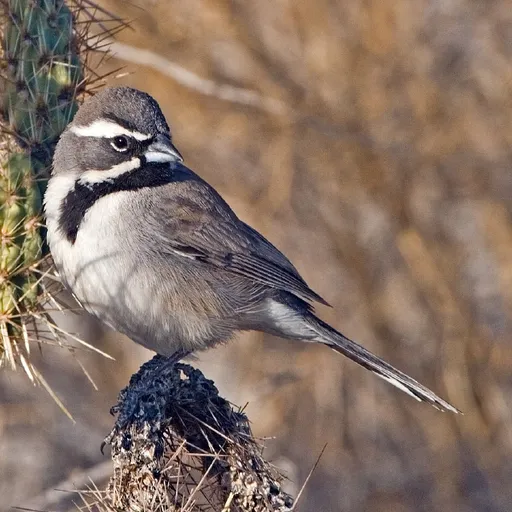
Black-throated Sparrow
Amphispiza bilineata
Least Concern
Overview
The black-throated sparrow is a small songbird in the family Passerellidae, found across a wide range in Mexico and the United States. It currently faces no immediate threats and is classified as Least Concern on the IUCN Red List, though its population is believed to be decreasing.
Identification
- Adults have a black forehead, grey crown and nape, and white supercilia and malar stripes bordered by thin black lines.
- The chin, throat, and upper breast are black, while the rest of the underparts are white with a plumbeous tinge on the sides.
- Size is between 12 and 14 cm in length with a wingspan of about 19.5 cm, and legs are black or brownish plumbeous.
- Song typically consists of an introduction with notes followed by a buzz and a repetitive section of trills, rendered as "chee-whee, whit, wher'r'r'r".
Habitat
This species primarily inhabits dry to arid semi-open landscapes with well-spaced shrubs and small trees such as mesquite and juniper, including scrublands, thorn bush, alluvial fans, canyons, and badlands. It is found from north-central Texas and Colorado through to Mexico, with isolated records in Canada and the eastern United States, and occasionally visits grassy fields during migration.
Diet
During the breeding season, the bird feeds mainly on insects with significant amounts of seeds and other plant material, while in winter its diet consists almost entirely of seeds. It forages mostly by hopping on the ground and gleaning prey from low vegetation.
Did you know?
The black-throated sparrow is the only remaining species in its genus after the five-striped sparrow and others were reclassified, though some authorities still include the five-striped sparrow with it. Its population has an estimated 62 million mature individuals.
Sources
- Wikipedia · CC BY-SA 4.0
- Wikidata · CC0 1.0