
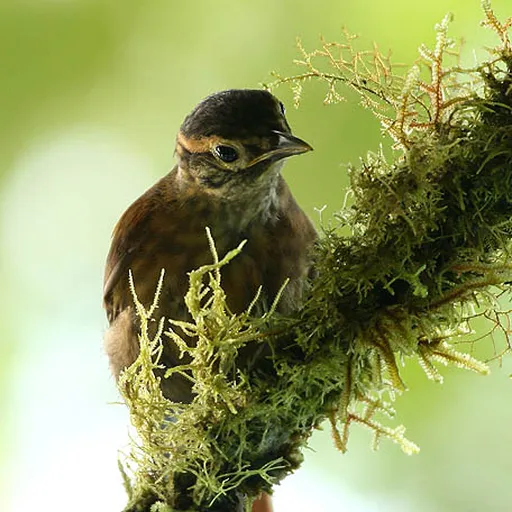
Scaly-throated Foliage-gleaner
Anabacerthia variegaticeps
Least Concern
Listen
XC248562 · Niels Krabbe · Pichincha: ridge between Río Mindo and Río Nambillo, 3 km SE Mindo, Ecuador · CC BY-SA 4.0
Overview
The scaly-throated foliage-gleaner, also known as the spectacled foliage-gleaner, is a medium-sized bird in the ovenbird family Furnariidae. It is found across Central America, with populations in Mexico, Colombia, and Ecuador. The species is currently classified as Least Concern on the IUCN Red List.
Identification
- Length ranges from 15 to 17 cm with a weight of 19 to 25 g, featuring a wedge-shaped bill and dull yellowish green to olive-green legs.
- Adults possess a wide ochraceous buff eyering and supercilium, a dark brown line behind the eye, and a pale whitish buff throat with a faint scalloped appearance.
- The crown is dull grayish brown, the back and rump are rich rufescent brown, and the tail is chestnut.
- Song consists of 15–20 squeaky, sharp 'squeak' or 'skew' notes that last several seconds, often ascending and then descending, or described as a fast-paced series of piercing 'skee' or 'tjik' notes.
Habitat
The species inhabits semi-deciduous forest, rainforest, cloudforest, and montane evergreen forest in the foothills and subtropical zones. Elevations range from 350 to 2,500 m in northern Central America, 800 to 1,800 m in Costa Rica, and 600 to 2,000 m in Colombia, with Ecuadorian populations found between 700 and 1,700 m.
Diet
It feeds on a wide variety of arthropods, foraging singly, in pairs, or within mixed-species feeding flocks. Foraging occurs at all forest levels, from understory to canopy, as the bird clambers and hops along horizontal branches to acrobatically glean prey from foliage, epiphytes, and moss.
Did you know?
The only known nest for this species was located in an abandoned woodpecker hole, which contained a thick layer of moss at the bottom. The clutch consisted of two eggs, but little else is known about the breeding biology of the species.
Sources
- Wikipedia · CC BY-SA 4.0
- Wikidata · CC0 1.0