
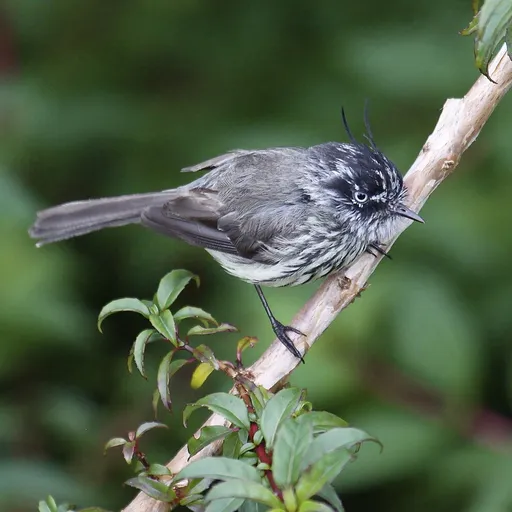
Tufted Tit-Tyrant
Anairetes parulus
Least Concern
Listen
XC248441 · Niels Krabbe · Pichincha: Laguna Negra, Mojanda Mts., Ecuador · CC BY-SA 4.0
Overview
The tufted tit-tyrant (Anairetes parulus) is a small species of bird in the tyrant flycatcher family found in western South America. It is the most abundant and widely distributed of the tit-tyrant species, inhabiting a range that stretches from southern Colombia to Tierra del Fuego.
Identification
- Very small bird, averaging 9.5 to 11 cm in length, with a long, conspicuous black crest that is often parted to appear as two crests.
- Black head with white supraloral and postocular stripes; dull grayish-brown back contrasting with a white throat and breast covered in black streaks and a pale yellow belly.
- Black bill and legs, creamy white to pale yellow irises, and two narrow white wingbars on the wings.
- Loud, high-pitched song including a rapid chuit-chuit-chuit phrase and a long, weak trill.
Habitat
This species prefers upper montane forests and shrublands but is a habitat generalist also found in elfin forest, cloud forest edges, and dry thorn scrub. It is mostly restricted to the Andes mountains in the northern portion of its range, while in the south its distribution broadens to include the coast.
Diet
The tufted tit-tyrant is a generalist feeder that eats mainly insects, occasionally consuming seeds. It forages actively in pairs or small family groups, often in leapfrog style while maintaining visual contact, and prefers to hunt in shrubs with small leaves. Its primary hunting strategy involves gleaning insects from perches, scanning upwards into vegetation before making deliberate attacks.
Did you know?
Members of the genus Anairetes are known in Spanish as Cachudito, which means 'little longhorn', a reference to the bird's prominent crest. They are also commonly called tit-tyrants because their active foraging behaviour and crests are reminiscent of the true tits in the family Paridae.
Sources
- Wikipedia · CC BY-SA 4.0
- Wikidata · CC0 1.0