
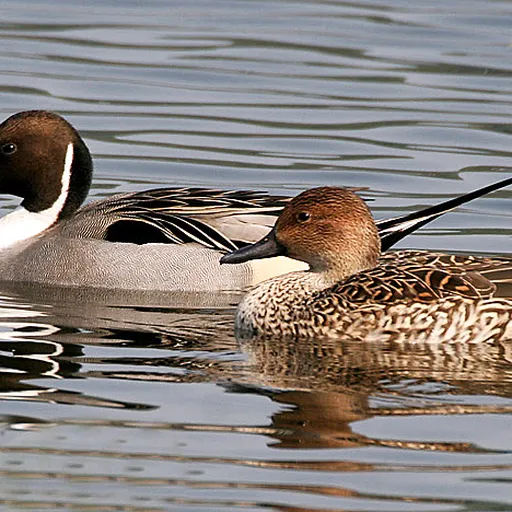
Northern Pintail
Anas acuta
Least Concern
Listen
XC730777 · Sonothèque ADVL · Sougéal, Ille-et-Vilaine, Bretagne, France · CC0 1.0
Overview
The northern pintail (Anas acuta) is a large dabbling duck species that breeds across the northern Palearctic and North America, migrating south to the equator for winter. It is characterised by its slender build, long neck, and the striking elongated central tail feathers of the breeding male.
Identification
- The drake has a chocolate-brown head, a white breast, and a white stripe running down the side of the neck, contrasting with grey upperparts and long, pointed grey tail feathers.
- Both sexes possess blue-grey bills, blue-grey legs, and a slender, elongated body shape with a relatively long neck.
- The female displays mottled light brown plumage with a shorter pointed tail, while the male's call is a soft, flute-like whistle and the female's is a descending quack.
- In flight, the species has a very fast, swept-back wing posture; the male shows a black speculum with a white border and pale rufous at the front, while the female has a dark brown speculum with a prominent white border at the back.
Habitat
Breeding habitat consists of open, unwooded wetlands such as wet grasslands, lake shores, and tundra, often with nests situated some distance from water. In winter, the bird utilises a wider range of open habitats including sheltered estuaries, brackish marshes, and coastal lagoons. It may be present year-round in parts of its range, such as Great Britain and the northwestern United States.
Diet
The pintail feeds primarily by dabbling and upending in shallow water, using its long neck to reach food in water up to 30 cm deep. Its winter diet is mainly plant material, including seeds and rhizomes of aquatic plants, while during the breeding season it consumes invertebrates such as aquatic insects, molluscs, and crustaceans.
Did you know?
Despite its enormous global range, the northern pintail has no geographical subspecies if Eaton's pintail is treated as a separate species. The bird can traverse transoceanic distances, with one individual ringed in Labrador, Canada, being recovered in England just nine days later.
Sources
- Wikipedia · CC BY-SA 4.0
- Wikidata · CC0 1.0