
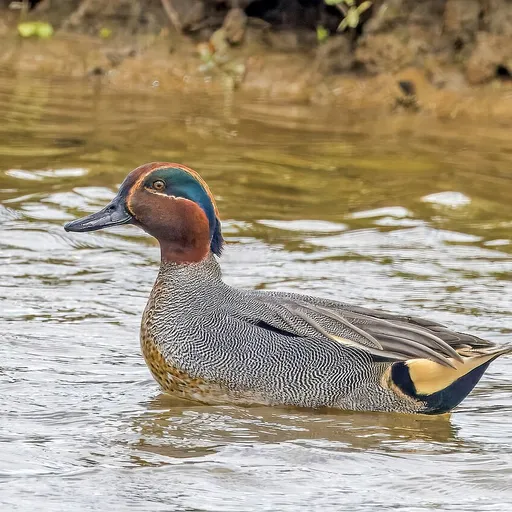
Eurasian Teal
Anas crecca
Least Concern
Listen
XC705896 · Sonothèque ADVL · Dragey-Ronthon, Manche, Normandie, France · CC0 1.0
Overview
The Eurasian teal (Anas crecca) is a common and widespread small dabbling duck that breeds in temperate Eurosiberia and migrates south in winter. Often called simply the teal in much of its range due to its dominance among similar species, it is a highly gregarious bird that forms large flocks outside the breeding season.
Identification
- Drakes in breeding plumage feature a chestnut head, an iridescent dark green half-moon patch around the eye bordered by thin yellowish-white lines, and a white stripe running along the flanks.
- Females are yellowish-brown with a dark greyish-brown upper head and neck, resembling a tiny mallard when at rest.
- Size is notably small, measuring 34–43 cm in length with a wingspan of 53–59 cm.
- The male call is a distinctive whistle resembling 'cryc' or 'creelycc', while the female produces a 'keh' or 'neeh' quack.
Habitat
Breeding occurs in sheltered freshwater wetlands with tall vegetation, such as taiga bogs and small lakes with extensive reedbeds, while wintering habitats include brackish waters, sheltered inlets, and coastal lagoons. The species has a vast Palearctic breeding range that migrates south to winter grounds including the Mediterranean, South Asia, and parts of Africa.
Diet
Feeding behaviour involves dabbling, upending, or grazing, and occasionally diving for food. During the breeding season, the diet consists mainly of aquatic invertebrates such as crustaceans, insect larvae, molluscs, and worms, but shifts to a largely granivorous diet of aquatic plant seeds, sedges, and grasses in winter.
Did you know?
The specific name 'crecca' is onomatopoetic, derived from the Swedish name for the species, referring to the male's characteristic call which sounds like a 'cryc'. This vocalisation is so defining that similar names in Norwegian, Danish, and German also translate to 'the duck that says cryc'.
Sources
- Wikipedia · CC BY-SA 4.0
- Wikidata · CC0 1.0