
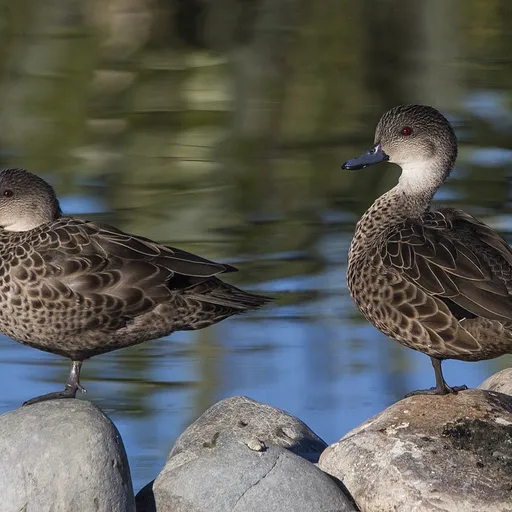
Grey Teal
Anas gracilis
Least Concern
Overview
The grey teal (Anas gracilis) is a dabbling duck found in open wetlands across Australia, New Zealand, and parts of the Pacific. It is a gregarious and nomadic species that rapidly colonises suitable habitats following rainfall events, earning the reputation as a great avian nomad.
Identification
- Mottled brown plumage with white and green flashes on the wings, featuring a plain or slightly streaked head with a dark crown and cream-coloured chin, throat, and cheeks.
- Distinctive crimson coloured iris, which is more prominent in adult males.
- Blue-grey bill with dark lining around the edges and grey feet.
- Vocal at night, with the male producing a soft whistle and the female a loud quack.
Habitat
Prefers shallow water areas such as lagoons, swamps, and shallow freshwater lakes with sizeable marginal vegetation cover, typically at elevations below 300 m. Found across Australia, New Zealand, New Guinea, and Indonesia, with vagrant records in the Solomons and New Caledonia. It is a self-introduced species in New Zealand, where it is now a common waterbird known locally as tētē.
Diet
Feeds primarily on invertebrates like midge larvae, water beetles, and caddisflies, as well as aquatic plant seeds, with the latter constituting 87–97% of the diet in Australia. Forages by dredging estuary mudflats, dabbling and upending in shallow water, or stripping seeds from aquatic vegetation. Feeding often occurs in pairs or family groups during the breeding season, switching to flocks thereafter.
Did you know?
Grey teal are believed to use their sense of smell and detection of low-frequency sounds from distant thunderstorms, hundreds of kilometres away, to navigate and locate suitable wetland habitats. This adaptability allows them to undertake long-distance flights of up to 1,200 km to escape drought or seek resources.
Sources
- Wikipedia · CC BY-SA 4.0
- Wikidata · CC0 1.0