
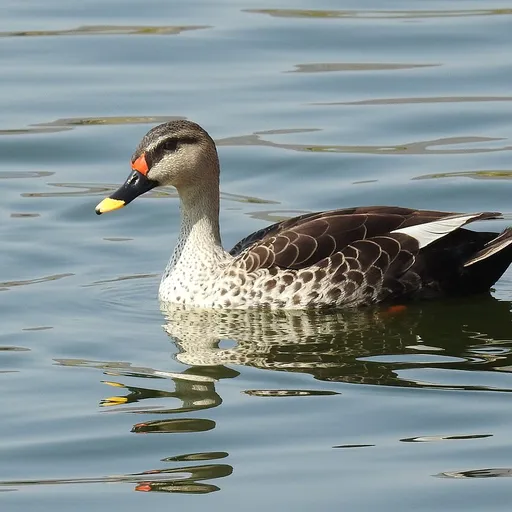
Indian Spot-billed Duck
Anas poecilorhyncha
Least Concern
Overview
The Indian spot-billed duck (Anas poecilorhyncha) is a large dabbling duck found throughout freshwater wetlands in the Indian subcontinent. As its name suggests, the mainland population is distinguished by a red spot at the base of the bill. It is a non-migratory breeding species classified as Least Concern on the IUCN Red List.
Identification
- Roughly the size of a mallard, this mainly grey duck has a paler head and neck with a scaly body pattern.
- The bill is black tipped with bright yellow, featuring orange-red spots at the base in males, which are absent or inconspicuous in females and the haringtoni subspecies.
- White tertials form a noticeable stripe on the side when in water, and the green speculum has a broad white band at the base in flight.
- Legs and feet are bright orange to coral red, while juveniles appear browner and duller than adults.
Habitat
This species resides in freshwater lakes and marshes across Pakistan and India, as well as parts of Myanmar, southern China, and Laos. It prefers medium-sized wetlands with vegetation cover and tends to avoid very large patches of open water. While primarily a resident, some individuals migrate, and northern populations have expanded their range northwards by over 500 km since the early 20th century.
Diet
The Indian spot-billed duck feeds by dabbling for plant food, including crops such as rice, and invertebrates including snails. Foraging typically occurs in the evening or at night. Through consuming snails like Lymnaea luteola, the birds may also ingest cercarian trematodes such as Echinoparyphium bagulai.
Did you know?
When disturbed, especially during moulting, these ducks can dive and remain underwater to evade capture, having historically been hunted in British India for their excellent taste. They have been observed taking off nearly vertically from the water when startled.
Sources
- Wikipedia · CC BY-SA 4.0
- Wikidata · CC0 1.0