
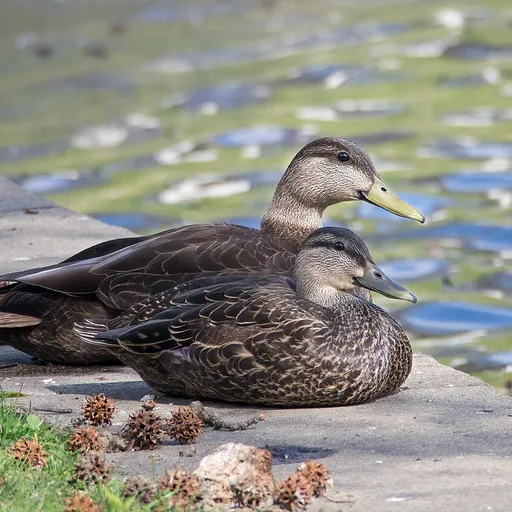
American Black Duck
Anas rubripes
Least Concern
Overview
The American black duck is a large dabbling duck that was described by William Brewster in 1902. It is the heaviest species in the genus Anas and is considered a species of least concern by the IUCN, although some populations are in decline.
Identification
- The plumage is dark, resembling the female mallard but darker overall, with a brown head slightly lighter than the darker brown body and streaked cheeks and throat.
- Males possess a distinct yellow bill, whereas females have a dull green bill with dark marks on the upper mandible.
- In flight, the white lining of the underwings contrasts sharply with the blackish underbody, and the iridescent violet-blue speculum lacks white bands at the front and rear.
- Females produce a loud sequence of quacks that fall in pitch, similar to those of the mallard.
Habitat
Native to eastern North America, this duck is a habitat generalist found in coastal and freshwater wetlands, brackish marshes, and estuaries across Canada and the United States. During the breeding season, it is usually found in the Great Lakes, the Adirondacks, and from Saskatchewan to the Atlantic in Canada, while it mostly winters in the east-central United States, particularly in coastal areas.
Diet
This omnivorous species feeds by dabbling in shallow water and grazing on land, consuming wetland grasses, sedges, and aquatic plants, as well as mollusks, insects, and small fishes. The diet shifts seasonally, consisting of roughly 80% plant food and 20% animal food during the breeding season, but reversing to 85% animal food during winter.
Did you know?
Recent research conducted for the Delta Waterfowl Foundation suggests that the extensive hybridization between American black ducks and mallards is a result of forced copulations rather than a normal pairing choice by black hens.
Sources
- Wikipedia · CC BY-SA 4.0
- Wikidata · CC0 1.0