
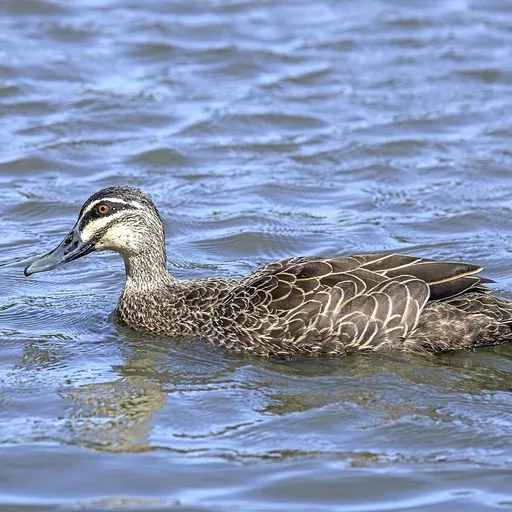
Pacific Black Duck
Anas superciliosa
Least Concern
Overview
The Pacific black duck (Anas superciliosa), commonly known as the PBD, is a dabbling duck found in much of Indonesia, New Guinea, Australia, New Zealand, and many islands in the southwestern Pacific. In New Zealand, it is usually called the grey duck and is also known by its Māori name, pārera.
Identification
- Has a dark body with a paler head featuring a dark crown and facial stripes.
- Displays a green speculum and pale underwing in flight.
- Size range is 54–61 cm, with males tending to be larger than females.
- Female produces a sequence of raucous, rapid quacking which decreases in volume.
Habitat
This sociable duck is found in a variety of wetland habitats. Its range extends from the Caroline Islands in the north to French Polynesia in the east, including Indonesia, New Guinea, Australia, and New Zealand.
Diet
The Pacific black duck is mainly vegetarian, feeding on seeds of aquatic plants, which are supplemented with small crustaceans, molluscs, and aquatic insects. It forages by 'dabbling', plunging its head and neck underwater and upending to raise its rear end vertically out of the water. Occasionally, food is also sought on land in damp grassy areas.
Did you know?
The now-extinct Mariana mallard was probably originally derived from hybrids between the Pacific black duck and mallards that arrived on the islands during migration. Studies suggest that the eventual loss of the grey duck as a separate species in New Zealand may be due to hybridisation, where the mallard phenotype is dominant, making species ancestry difficult to determine from plumage alone.
Sources
- Wikipedia · CC BY-SA 4.0
- Wikidata · CC0 1.0