
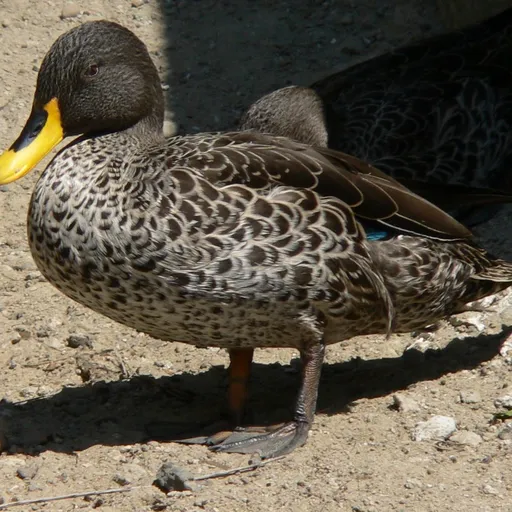
Yellow-billed Duck
Anas undulata
Least Concern
Overview
The yellow-billed duck (Anas undulata) is a mallard-sized dabbling duck found as an abundant resident in southern and eastern Africa. It is not migratory, though it wanders during the dry season to locate suitable waters, and is highly gregarious outside the breeding season.
Identification
- Primarily grey plumage with a darker head and a bright yellow bill.
- Wings are whitish below and feature a white-bordered green speculum when viewed from above.
- Males produce a teal-like whistle, while females emit a mallard-like quack.
- Measures 51–58 cm in length, with sexes appearing similar, though juveniles are slightly duller.
Habitat
It inhabits freshwater areas in fairly open country, though it is rarely found in suburban environments near golf courses, parks, or lakes. The species is distributed across southern and eastern Africa.
Diet
It feeds by dabbling for plant food, typically foraging mainly in the evening or at night.
Did you know?
Unlike most other African waterfowl that finish moulting lighter than they started, yellow-billed ducks lose about a quarter of their body mass during the first half of moulting but regain all of it by the end. Additionally, males perform all seven major courtship displays observed in African ducks, a trait likely driven by their lack of sexual dichotomy.
Sources
- Wikipedia · CC BY-SA 4.0
- Wikidata · CC0 1.0