
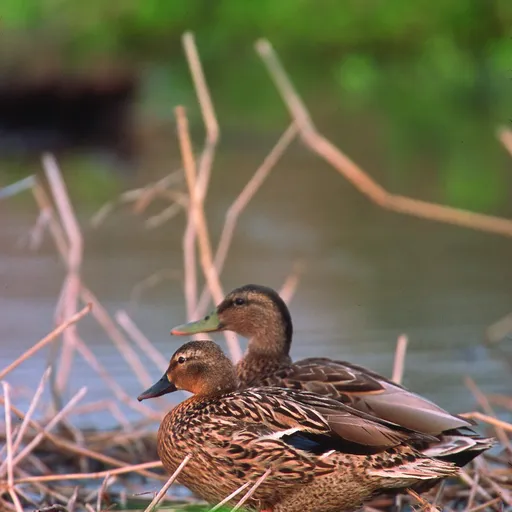
Hawaiian Duck
Anas wyvilliana
Vulnerable
Overview
The Hawaiian duck, or koloa maoli, is a species of bird in the family Anatidae that is endemic to the large islands of Hawaiʻi. It is a non-migratory, monomorphic species that is closely allied with the mallard but is now recognised as a distinct species within the mallard complex. Listed as Vulnerable on the IUCN Red List, the species faces significant threats from hybridisation with feral mallards.
Identification
- Mottled brown plumage resembling a female mallard, with males typically having a darker head and neck.
- Speculum feathers are green to blue, bordered on both sides by white, while the tail is dark overall.
- Bill is olive green in males and dull orange with dark markings in females; feet and legs are orange to yellow-orange.
- Quacks like a mallard, but with a softer call and less frequent vocalisation.
Habitat
Formerly ranging across all main Hawaiian islands except Lānaʻi and Kaho'olawe, the species now primarily resides in the tall wetland grasses and streams near the Kohala volcano on the main island of Hawaiʻi. Pure populations are currently found only on Kauaʻi, though the species was reestablished on Oʻahu, Hawaiʻi, and Maui. They inhabit low wetlands, river valleys, and mountain streams up to 7,000 feet in elevation.
Diet
Hawaiian ducks are opportunistic feeders that consume freshwater vegetation, mollusks, insects, and other aquatic invertebrates. Specific diet items include snails, insect larvae, earthworms, tadpoles, crayfish, mosquito larvae, mosquito fish, grass seeds, rice, and green algae.
Did you know?
The species arose through ancient hybridisation between the mallard and the Laysan duck, yet remains capable of interbreeding with feral mallards to produce fully fertile offspring. This ongoing hybridisation is considered one of the main causes for the endangerment of the Hawaiian duck.
Sources
- Wikipedia · CC BY-SA 4.0
- Wikidata · CC0 1.0