
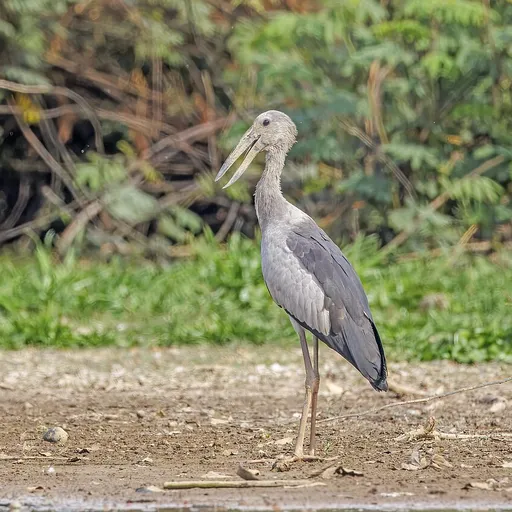
Asian Openbill
Anastomus oscitans
Least Concern
Overview
The Asian openbill or Asian openbill stork, Anastomus oscitans, is a large wading bird in the stork family Ciconiidae. It is a broad-winged soaring bird that relies on moving between thermals of hot air for sustained flight. While relatively small for a stork, it is distinctive due to the gap between its arched upper and recurved lower mandibles in adults.
Identification
- Predominantly greyish in non-breeding and white in breeding season, with glossy black wings and tail that have a green or purple sheen.
- Adults possess a distinctive gap between the beak mandibles, a feature absent in young birds.
- Short legs that are pinkish to grey, becoming reddish prior to breeding.
- Silhouette may resemble a white stork or Oriental stork at a distance.
Habitat
The species is found mainly in the Indian subcontinent and Southeast Asia, with a recent expansion into southwestern China. Usual foraging habitats include inland wetlands, crop fields, irrigation canals, and seasonal marshes, though river banks and tidal flats are rarely used. Individuals are resident within their range but make long-distance movements in response to weather and food availability.
Diet
Feeds mainly on large molluscs, especially Pila species, by inserting the tip of the lower mandible into the shell to extract the body. Smaller snails are often swallowed whole or crushed, and the diet also includes water snakes, frogs, and large insects. Birds forage by making rapid vertical jabs in shallow water with the head and neck partially submerged.
Did you know?
In Xishuangbanna, south China, 45 Asian openbills were found dead after a single hailstorm, while carcasses of other bird species were not observed. The species was historically shot by sportsmen in colonial India for meat, where it was known as the 'beef-steak bird'.
Sources
- Wikipedia · CC BY-SA 4.0
- Wikidata · CC0 1.0