
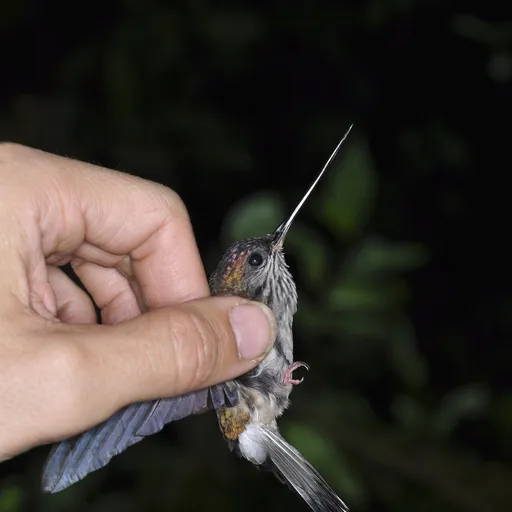
Tooth-billed Hummingbird
Androdon aequatorialis
Least Concern
Overview
The tooth-billed hummingbird (Androdon aequatorialis) is a monotypic species within the family Trochilidae, characterised by its distinctively serrated bill. It is classified as Least Concern by BirdLife International, though it remains generally scarce and localized.
Identification
- A total length of approximately 14 cm, including a long, essentially straight bill that measures about 4 cm.
- Shiny green upperparts with a coppery crown, contrasting with whitish underparts streaked in dusky tones.
- A conspicuous white band on the rump and a rounded, greyish tail with a broad black subterminal band and white tips.
- Males possess a small hook at the bill's tip and more prominent tooth-like spikes, with slightly brighter plumage than females.
Habitat
Restricted to humid primary forests and nearby second growth in western Colombia, north-western Ecuador, and far eastern Panama. Altitude preferences vary by region, ranging from 400–800 m in Ecuador to 600–1,560 m in Panama.
Diet
Forages from low levels to the sub-canopy, primarily trap-lining for nectar from flowers of families such as Ericaceae and Gesneriaceae. The serrated bill aids in catching small spiders and insects, while males' hooked tips help extract prey from rolled leaves and cavities.
Did you know?
In Ecuador, males gather in leks between February and May, a mating behaviour that is unusual for members of the subfamily Trochilinae but more common in Phaethornithinae.
Sources
- Wikipedia · CC BY-SA 4.0
- Wikidata · CC0 1.0