
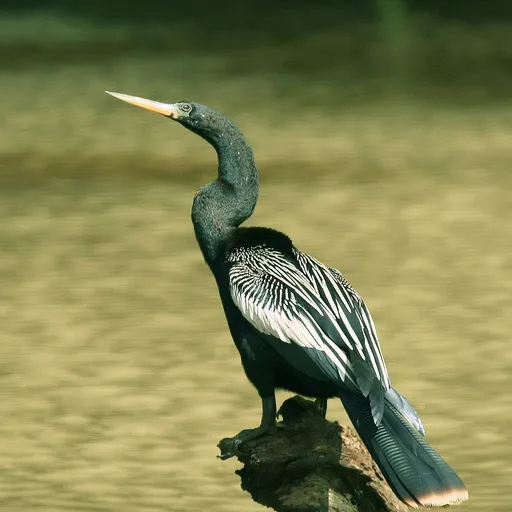
Anhinga
Anhinga anhinga
Least Concern
Overview
The anhinga, also known as the American darter or snakebird, is a large water bird found in the warmer parts of the Americas. It belongs to the darter family and is closely related to other darters found in Africa, Asia, and Australia.
Identification
- Males are glossy black-green with white-spotted backs and a grey or light purple-white neck, while females have pale grey-buff heads and necks with chestnut breasts.
- Features a sharply pointed, yellow bill that is approximately twice the length of the head, along with yellow webbed feet.
- Possesses a long, fan-like tail that is wider and longer than that of a double-crested cormorant, and a 'kinked' neck due to unique cervical vertebrae morphology.
- Distinguished from cormorants by its ability to glide in flight, its straight bill without a hook-tip, and its habit of spreading wings in a semicircle to dry, resembling a male turkey.
Habitat
Anhingas inhabit warm, shallow waters and swamplands across the Americas, ranging from the southern United States and Mexico through the Caribbean and South America east of the Andes. Birds at the extreme northern or southern edges of their range may migrate towards the equator during winter to access sufficient sunshine.
Diet
This species feeds on moderately sized wetland fishes, amphibians, aquatic invertebrates, and insects, sometimes including small terrapins and water snakes. It hunts by swimming underwater and spearing prey with its sharp beak, often using both jaws for larger fish or only the lower jaw for smaller ones, before bringing the capture to the surface to swallow head-first.
Did you know?
Anhingas lack external nostrils and breathe solely through their epiglottis via small opercula at the corners of the beak. This adaptation allows them to fully submerge and hunt underwater without water entering their airways.
Sources
- Wikipedia · CC BY-SA 4.0
- Wikidata · CC0 1.0