
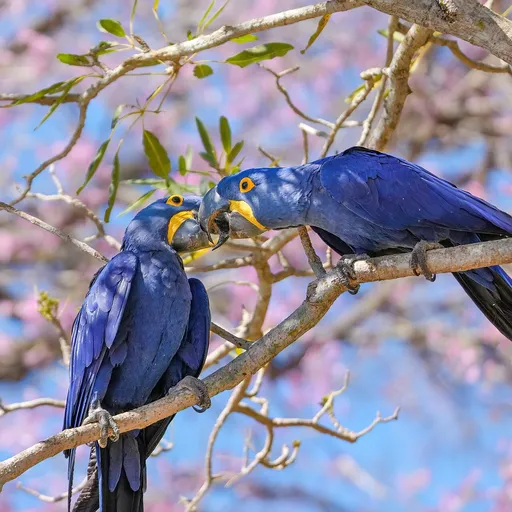
Hyacinth Macaw
Anodorhynchus hyacinthinus
Vulnerable
Overview
The hyacinth macaw (Anodorhynchus hyacinthinus) is the largest flying parrot species in the world, native to central and eastern South America. It is currently classified as Vulnerable on the IUCN Red List due to habitat loss and trapping for the pet trade.
Identification
- Plumage is mostly blue, lighter above, with large black sections on the underwing and undertail.
- Features a strong, vibrant yellow ring around the eyes and the area just beneath the beak.
- Measures approximately 1 metre in length from head to tail tip.
- Possesses a long, pointed tail and an enormous beak capable of cracking hard nuts.
Habitat
Found in semi-open, somewhat wooded habitats such as savannah grasslands, dry thorn forests, and palm swamps, while avoiding dense, humid forest interiors. Its range includes the Pantanal region of Brazil, adjacent areas of Bolivia and Paraguay, and specific river basins in the eastern Amazon. In some areas, it is also found in anthropogenic habitats like cattle ranches.
Diet
Feeds primarily on nuts from specific palm species, such as the acuri and bocaiuva palms, using its powerful beak to crush hard shells. It also consumes fruits and other vegetable matter, travelling vast areas to find the ripest food. In the wild, the hard acuri nut must pass through the digestive system of cattle to become accessible to the parrot.
Did you know?
The hyacinth macaw exhibits tool use by incorporating chewed leaves or pieces of wood to prevent hard nuts from slipping while it gnaws them open. Additionally, it is one of the only birds with the jaw strength, requiring 300 psi of pressure, necessary to crack a macadamia nut.
Sources
- Wikipedia · CC BY-SA 4.0
- Wikidata · CC0 1.0