
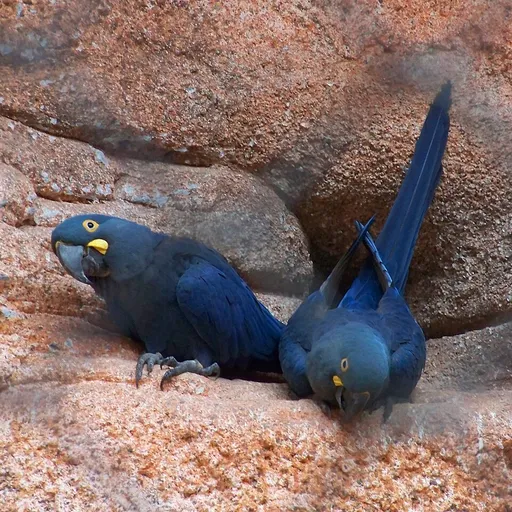
Lear's Macaw
Anodorhynchus leari
Endangered
Overview
Lear's macaw, also known as the indigo macaw, is a large, all-blue Brazilian parrot classified as endangered. It was first described in 1856, though its wild population was not discovered until 1978, and intensive conservation efforts have increased the world population approximately thirtyfold in the first two decades of the 21st century.
Identification
- 70–75 cm long, weighing around 950 g, with a dark metallic blue body, tail and wings featuring a faint green tinge and a slightly paler head.
- A heavy, black bill with a patch of pale-yellow skin at the base and orange-yellow eye rings.
- Dark grey feet.
Habitat
The species inhabits a dry, desert-like shrubby environment known as caatinga in the interior northeast of Brazil, specifically within the municipalities of Campo Formoso, Canudos, Euclides da Cunha, Jeremoabo, Monte Santo, Novo Triunfo, Paulo Afonso, Santa Brígida and Sento Sé. It roosts and nests in cavities in sandstone cliffs formed by streams cutting through outcrops.
Diet
The primary diet consists of the nuts of the Syagrus coronata palm, with individuals consuming as many as 350 per day, and the macaws forage in groups, tearing the fibrous pulp from the fruit to access the hard-shelled nut. They also feed on the seeds of Melanoxylon, Jatropha mollissima, Dioclea, Spondias tuberosa, Schinopsis brasiliensis and Zea mays, as well as the flowers of Agave. A unique aspect of their foraging is the retrieval of regurgitated palm nuts from cattle, which have eaten the fruit but expelled the seeds.
Did you know?
The bird's heavy, chisel-shaped bills appear to have evolved specifically to crack the thick shells of Syagrus coronata palm nuts, and flocks will often congregate at cattle corrals to collect seeds regurgitated by livestock, effectively simulating the seed dispersal role once played by extinct megafauna.
Sources
- Wikipedia · CC BY-SA 4.0
- Wikidata · CC0 1.0