
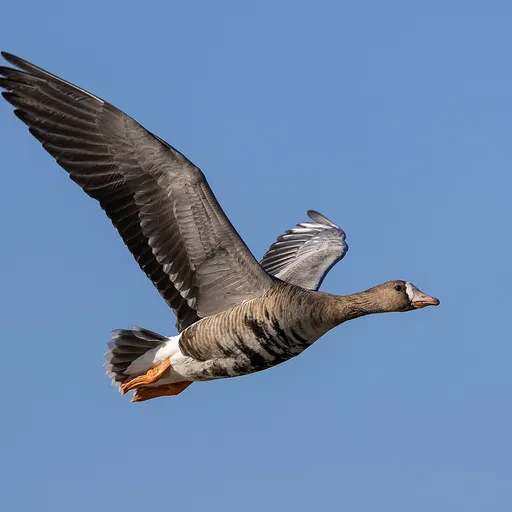
Greater White-fronted Goose
Anser albifrons
Least Concern
Listen
XC1079945 · Sonothèque ADVL · Miniac-Morvan, Ille-et-Vilaine, Bretagne, France · CC0 1.0
Overview
The greater white-fronted goose (Anser albifrons) is a migratory species of goose, closely related to the smaller lesser white-fronted goose. It is classified as Least Concern on the IUCN Red List, though the Greenland subspecies has experienced a continuous decline in the early 2000s. The bird is known for its distinctive white facial blaze and salt-and-pepper breast markings, which have led to the colloquial North American name 'specklebelly'.
Identification
- Size and Plumage: 64–81 cm in length with a 130–165 cm wingspan; greyish brown body with light grey breasts dappled with dark brown to black blotches and bars.
- Head and Bill: Features a white patch bordering the base of the bill, known as a facial blaze; the bill is pinkish in most subspecies, but orange-yellow in the Greenland subspecies (A. a. flavirostris).
- Legs and Markings: Bright orange legs and mouse-coloured upper wing coverts; adults possess prominent salt-and-pepper markings on the breast.
- Vocalisation: Notable for a high-pitched cackle imitated by 'he-he' sounds, with a distinct break in the note between the first and second cackle.
Habitat
The species breeds in the arctic regions of northern Canada, Alaska, Greenland, and Russia, and migrates to winter in North America, Europe, and Asia. In the British Isles, the Greenland subspecies overwinters in Scotland and Ireland, while the European subspecies overwinters in England and Wales, often gathering on farmland at traditional sites such as WWT Slimbridge. Ecological studies suggest the Greenland birds may warrant separate species status due to their distinct appearance and breeding patterns.
Did you know?
Greenland white-fronted geese exhibit an unusually long period of parental care and association that can last several years and include grandparenting, a trait possibly unique among the Anseriformes. This extended social structure contrasts with the brief three-month breeding window in the Arctic, which makes the species highly vulnerable to delayed snowmelt or late spring storms.
Sources
- Wikipedia · CC BY-SA 4.0
- Wikidata · CC0 1.0