
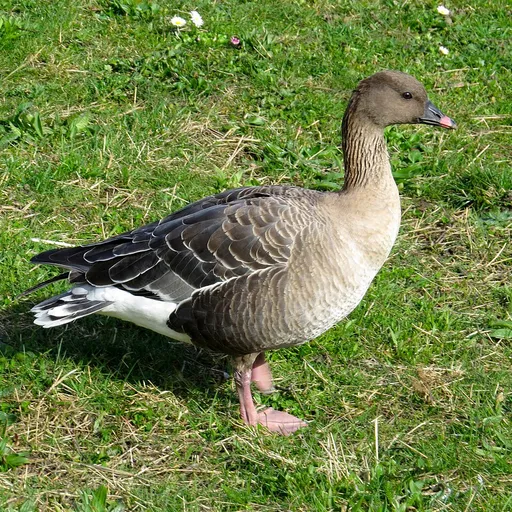
Pink-footed Goose
Anser brachyrhynchus
Least Concern
Listen
XC997273 · Bart Vastenhouw · Oostervallei, Vlieland, Friesland, Netherlands · CC BY 4.0
Overview
The pink-footed goose (Anser brachyrhynchus) is a medium-sized migratory goose that breeds in eastern Greenland, Iceland, Svalbard, and recently Novaya Zemlya. It is commonly known by the colloquial abbreviation 'pinkfoot' and is classified as Least Concern on the IUCN Red List.
Identification
- Medium-sized goose measuring 60–75 cm in length with a wingspan of 135–170 cm.
- Distinctive short bill that is bright pink in the middle with a black base and tip, accompanied by pink feet.
- Mid-grey-brown body with a darker brown head and neck, a white rump and vent, and a grey tail with a broad white tip.
- Vocal in flight, producing high-pitched honking calls that can be almost deafening when large flocks move together.
Habitat
Breeds in Arctic regions including eastern Greenland, Iceland, Svalbard, and Novaya Zemlya, with nests often situated on cliffs near glaciers or on lake islets to avoid mammalian predators. Winters primarily in northwest Europe, especially in Ireland, Great Britain, the Netherlands, and western Denmark.
Diet
The diet is almost entirely herbivorous, consisting of a wide range of tundra plants in summer and agricultural crops such as oilseed rape, sugar beet, potatoes, and grasses in winter. Grazing can cause extensive crop damage but may also benefit farmers by removing leftover plant material that spreads disease.
Did you know?
A new breeding population established on Novaya Zemlya within just ten years, a rapid expansion facilitated by climate change and social learning that is considered one of the most dramatic distribution changes in a migratory bird.
Sources
- Wikipedia · CC BY-SA 4.0
- Wikidata · CC0 1.0