
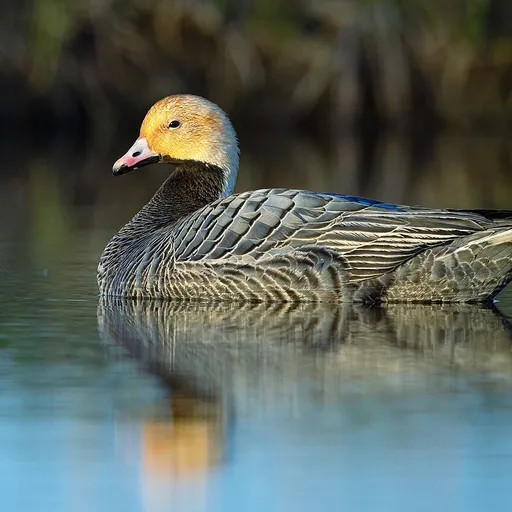
Emperor Goose
Anser canagicus
Least Concern
Overview
The emperor goose, also known as the beach goose or painted goose, is a waterfowl species in the family Anatidae. It breeds in remote coastal areas of the Bering Sea during the summer and migrates south to winter in ice-free regions of Alaska, the Aleutian Islands, and British Columbia.
Identification
- Stout blue-gray body with black and white spots creating a scaled appearance, with a white head and nape tinged with amber-yellow.
- Distinctive black chin and throat, a white tail, a pink bill tipped with white, and yellow-orange legs and feet.
- The underside of the wings is entirely gray, which distinguishes it from the snow goose that has black and white on the wing undersides.
- Adult heads may turn reddish-brown in summer due to feeding in iron-rich tidal pools, while vocalisations sound like "kla-ha, kla-ha" with a notably nasal quality.
Habitat
In summer, it inhabits Arctic and subarctic climates in the Bering Sea region, utilising freshwater pools, inland lakes, and coastal lagoons, with 90% of the population nesting on the Yukon-Kuskokwim Delta. For winter, it migrates to mudflats and rocky shores in the Aleutian Islands, Alaska Peninsula, and Kodiak Island, occasionally reaching as far south as northwestern California and British Columbia.
Diet
During the summer, the species feeds on vegetation such as shoots, roots, and berries, but its winter diet primarily consists of bivalve molluscs and algae. It forages at the edges of water bodies, using its sense of touch to catch molluscs in the sediment, which has earned it the common name Beach Goose.
Did you know?
Because its diet consists mostly of animals, particularly molluscs, the emperor goose has a distinctly strong flavour in its flesh compared to other goose species. It is also one of the least social goose species, ranking second only to the black brant in its lack of sociability.
Sources
- Wikipedia · CC BY-SA 4.0
- Wikidata · CC0 1.0