
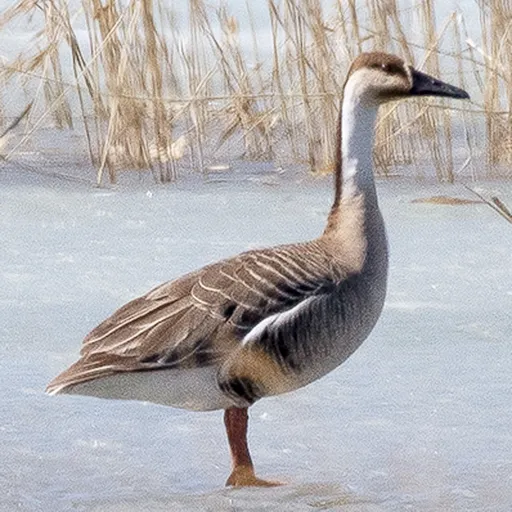
Swan Goose
Anser cygnoides
Endangered
Overview
The swan goose (Anser cygnoides) is a large, long-necked goose that is the longest member of its genus. It is classified as Endangered on the IUCN Red List due to ongoing population declines and habitat loss.
Identification
- Wild birds measure 81–94 cm in length with a wingspan of 160–185 cm.
- Upperparts are greyish-brown with a maroon hindneck and cap, while the underside is pale buff with darker streaks on the belly and flanks.
- The bill is completely black and heavy, surrounded by a thin white stripe at the base, with orange legs and feet.
- The voice is a loud, drawn-out, ascending honking 'aang', accompanied by a barking honk used as a warning call.
Habitat
Breeding occurs in inland Mongolia, Northeast China, and the Russian Far East, favouring steppe, taiga, and mountain valleys near freshwater. The species is migratory, wintering mainly in central and eastern China, with vagrant birds occasionally encountered in Japan, Korea, and other parts of Asia.
Diet
It grazes on plants such as sedges, grasses, and water plants, rarely swimming. During winter, it forages on plains and stubble fields, sometimes far from water sources.
Did you know?
Domesticated descendants of this species, known as the Chinese goose, have been bred since at least the mid-18th century and may date back to around 1000 BC, exhibiting a prominent bill knob and upright posture unlike their wild parent.
Sources
- Wikipedia · CC BY-SA 4.0
- Wikidata · CC0 1.0