
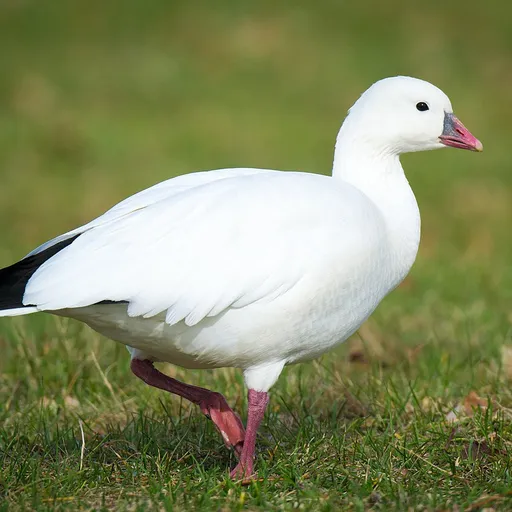
Ross's Goose
Anser rossii
Least Concern
Overview
Anser rossii is the smallest of the three white geese that breed in North America, characterized by a rounded head and a relatively short neck. Though once considered rare due to open hunting, the species is currently listed as Least Concern by the IUCN following dramatic population increases resulting from conservation measures.
Identification
- All-white plumage with distinctive black wingtips.
- Short, triangular bill with a bluish base featuring warty structures that become more prominent with age.
- Legs start as olive gray on goslings and turn deep red as they mature.
- Approximately 40% smaller than a white-phase snow goose, with a bill that is smaller in proportion to its body and lacks 'black lips'.
Habitat
Breeding landscapes in the central Arctic are dominated by flat plains, wet meadows, and marshy tundra, often featuring patches of dwarf birch, willow, and sedges. Nesting typically occurs on islands in shallow lakes and adjacent mainland areas, with colonies located in regions such as the Queen Maud Gulf and the McConnell River on the west coast of Hudson Bay.
Diet
As grazers, these birds feed primarily on grasses, sedges, and small grains. They frequently forage in large, mixed flocks alongside snow geese, though large nesting colonies can cause extensive damage to plants through overgrazing.
Did you know?
Members of the Hudson's Bay Company were the first Europeans to discover the arctic nesting grounds of these geese, which had previously been described by explorer Samuel Hearne under the name 'horned wavey' eight decades before John Cassin formally named the species after Bernard R. Ross.
Sources
- Wikipedia · CC BY-SA 4.0
- Wikidata · CC0 1.0