
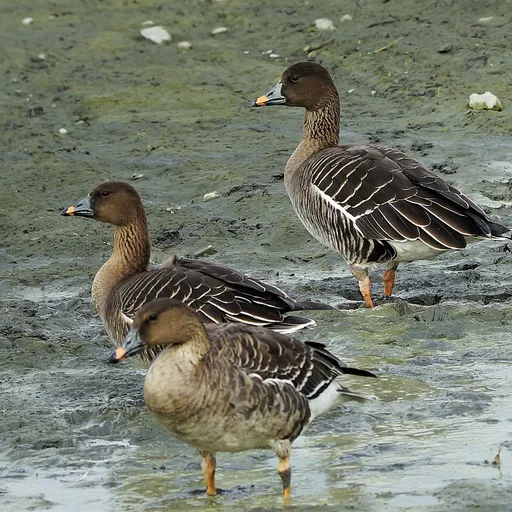
Tundra Bean Goose
Anser serrirostris
Listen
XC918829 · Sonothèque ADVL · Courtils, Manche, Normandie, France · CC0 1.0
Overview
The tundra bean goose (Anser serrirostris) is a migratory goose that breeds in northern Siberia and winters further south in Asia. It is recognised as a separate species by the American Ornithological Society and the International Ornithologists' Union, though some authorities consider it part of a single bean goose species.
Identification
- Length ranges from 68 to 90 cm, with a wingspan of 140 to 174 cm and a weight of 1.7–4 kg.
- The bill is black at the base and tip with an orange band across the middle, while the legs and feet are bright orange.
- Upper wing-coverts are dark brown with narrow white fringes.
- The voice is a loud honk that is higher pitched in the smaller subspecies.
Habitat
The bird breeds in the tundra regions of northern and east Siberia, specifically the nominate subspecies in Northern Russian tundra to the Taimyr Peninsula and the second subspecies in East Siberian tundra. It has no regular wintering sites and is found in small groups among other grey goose species, with some regular localities including WWT Slimbridge, Gloucestershire and Holkham Marshes, Norfolk.
Did you know?
The tundra and taiga bean geese diverged about 2.5 million years ago but re-established secondary contact around 60,000 years ago, resulting in extensive gene flow between the populations.