
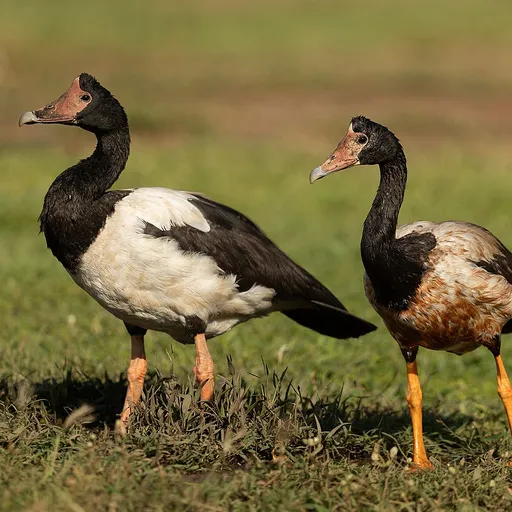
Magpie Goose
Anseranas semipalmata
Least Concern
Overview
The magpie goose (Anseranas semipalmata) is the sole living representative of the family Anseranatidae. This waterbird is found in northern Australia and southern New Guinea, where it maintains a stable presence through protective management despite historical declines in southern regions.
Identification
- Plumage: Striking black-and-white feathers present in both sexes.
- Size: Males range from 75–90 cm in length with a wingspan of 130–180 cm; females are slightly smaller at 70–80 cm.
- Structure: Possesses a long neck and legs, with orange feet and a long, hooked bill.
- Voice: Emits a loud, resonant honking sound.
Habitat
The species inhabits open wetland areas such as floodplains and swamps. It is currently widespread in northern Australia and southern New Guinea, though it has largely disappeared from southern Australia due to wetland drainage, with reintroduction projects now underway in some southern locations.
Diet
Magpie geese feed primarily on vegetation, including dry grass blades, grass seeds, spike rush bulbs, and wild rice. They forage by wading and swimming in their wetland habitats.
Did you know?
This bird is an early offshoot in the evolutionary lineage of waterfowl, with its family considered a living fossil that likely diverged before the Cretaceous–Paleogene extinction event. Males may mate with two females, and unlike some other polygamous species, all females participate in raising the young.
Sources
- Wikipedia · CC BY-SA 4.0
- Wikidata · CC0 1.0