
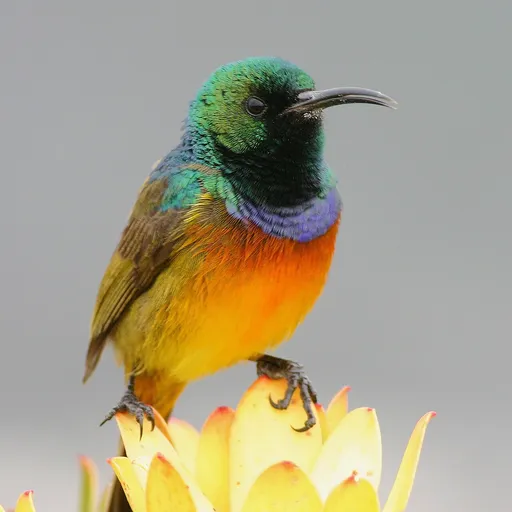
Orange-breasted Sunbird
Anthobaphes violacea
Least Concern
Overview
The orange-breasted sunbird (Anthobaphes violacea) is a small, predominantly nectar-feeding bird endemic to the fynbos shrubland biome of southwestern South Africa. It is the only member of the genus Anthobaphes and is classified as Least Concern on the IUCN Red List.
Identification
- Males have bright metallic green heads and throats, with violet upper breasts and bright orange lower breasts fading to yellow, while females are olive green and grey.
- Both sexes possess a long, decurved black bill, with males having a longer bill than females, along with black legs, feet, and dark brown eyes.
- Males feature a long, blackish tail with elongated central feathers that extend beyond the others.
- The call is described as a twangy, weak 'sshayrnk' or 'sskrang', often repeated several times.
Habitat
Restricted to the fynbos biome of South Africa's Western Cape, this species is closely associated with ericas and proteas. It is an altitudinal migrant that moves to higher elevations during the southern summer in search of flowers and is gregarious outside the breeding season, forming flocks of up to 100 birds.
Diet
The bird subsists mainly on flower nectar, particularly from ericas and proteas, while also consuming small insects and spiders often taken in flight. It perches on the ground to visit low-flowering plants and is known to steal nectar from flowers with longer corolla tubes.
Did you know?
The species is a key pollinator for Protea, Leucospermum, and Erica species. The frequent fires in its fire-prone habitat cause significant mobility, which may contribute to high genetic variability despite the bird's limited distribution range.
Sources
- Wikipedia · CC BY-SA 4.0
- Wikidata · CC0 1.0