
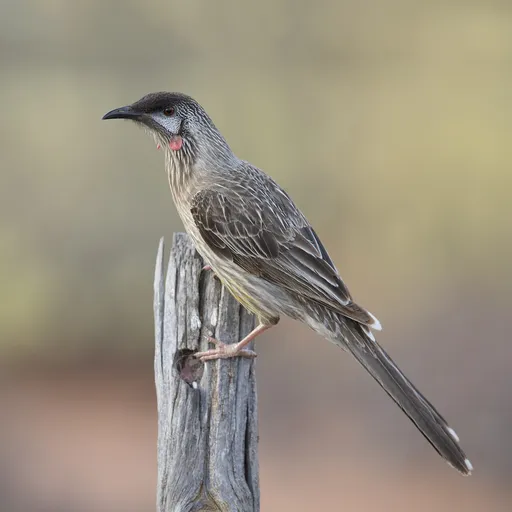
Red Wattlebird
Anthochaera carunculata
Least Concern
Overview
The red wattlebird (Anthochaera carunculata) is a passerine bird native to southern Australia and the second largest species of honeyeater in the region. Classified as Least Concern by the IUCN, it is a loud and conspicuous species that has become more common in some urban areas, although it has declined in places due to land clearing.
Identification
- Plumage: Mainly grey-brown with white streaks on the chest and a large bright yellow patch on the lower belly; sexes are similar.
- Wattles: Distinctive pinkish-red wattles dangle from the lower rear corner of the ear coverts on either side of the neck.
- Size and Bill: Ranges from 33 to 37 cm in length with a strong, downward-curving black bill.
- Vocalisations: Produces raucous calls, including a loud cackle from males and whistling calls from females, as well as harsh alarm calls.
Habitat
The species inhabits open sclerophyll forest and woodland, generally dominated by eucalypts, across southeast Queensland, New South Wales, Victoria, South Australia, and southwest Western Australia. It is a common visitor to urban environments, including parks, gardens, golf courses, orchards, and vineyards, and can be found at altitudes up to 1,900 m.
Diet
Primarily a nectar-feeder, it forages in trees by climbing along branches and probing flower heads, preferring plants like eucalypts, banksias, and grasstrees. It also consumes insects, usually caught by hawking, as well as berries and other fruit.
Did you know?
The bird possesses a long, specialized tongue that can extend well beyond the tip of its bill and divides at the end to form a brush-like structure with over a hundred bristles for extracting nectar by capillary action.
Sources
- Wikipedia · CC BY-SA 4.0
- Wikidata · CC0 1.0