
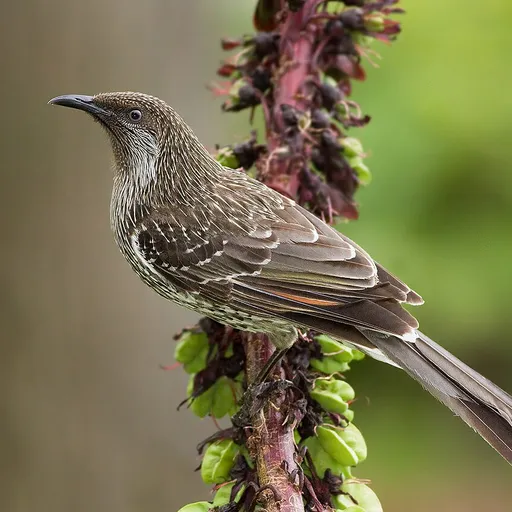
Little Wattlebird
Anthochaera chrysoptera
Least Concern
Overview
The little wattlebird, also known as the brush wattlebird, is a medium to large passerine bird in the honeyeater family Meliphagidae. It is notable as the smallest wattlebird, despite its size being comparable to the yellow and red wattlebirds. The species is classified as Least Concern on the IUCN Red List.
Identification
- The bird lacks the prominent wattles that characterise other members of the Anthochaera genus.
- Juveniles appear duller with less streaking and possess a browner eye compared to adults.
- Vocalisations include a strident cookay-cok, a raucous fetch the gun, and a mellow guttural yekkop, alongside squeaky, musical lilting notes.
- The alarm call is described as a kwock or shnairt!.
Habitat
Found in coastal and sub-coastal south-eastern Australia, the little wattlebird inhabits banksia and eucalypt woodlands, heathlands, tea-tree scrub, sandplain-heaths, lantana thickets, wild tobacco, as well as parks and gardens. Three subspecies are recognised across eastern and southeastern Australia, Kangaroo Island, and Tasmania.
Diet
Little wattlebirds feed on nectar using a long, brush-tipped tongue adapted for probing deep into flowers, and also consume insects, berries, and some seeds. Most feeding occurs while perched, though some insects are caught in mid-air, and birds may forage alone or in groups.
Did you know?
The female constructs the nest, which is described as a loose, untidy cup of twigs lined with shredded bark and placed 1 to 10 metres high in the fork of a banksia, tea-tree, or eucalypt sapling. Although the female incubates the eggs alone, both parents participate in caring for the young chicks.
Sources
- Wikipedia · CC BY-SA 4.0
- Wikidata · CC0 1.0