
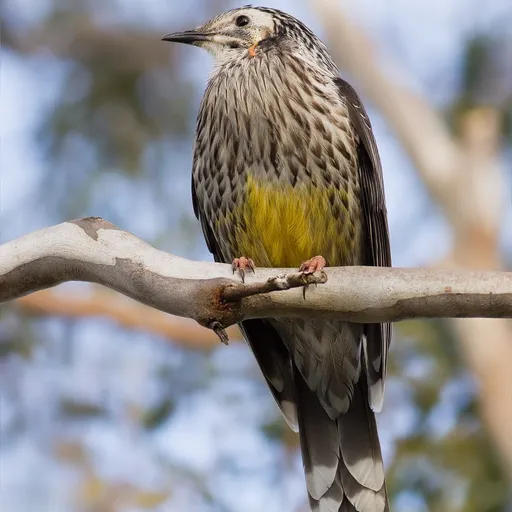
Yellow Wattlebird
Anthochaera paradoxa
Least Concern
Overview
The yellow wattlebird (Anthochaera paradoxa) is a species of honeyeater endemic to Tasmania and is the largest of the honeyeaters. It is a fairly tame bird that is common in eastern and central Tasmania, often found in gardens, forests, and shrubberies.
Identification
- A slim bird ranging from 37.5 to 45 cm in length, with a short, strong bill and a white face.
- Characterised by a long, pendulous yellow-orange wattle on the cheeks that becomes brighter during the breeding season.
- Plumage features a black-streaked crown, dark wings, grey to dusky brown upperparts, and a yellow belly.
- Calls are harsh, raucous, and grating, often compared to coughing or belching, producing a gurgling 'growk' or repeated 'clok' sound.
Habitat
The species inhabits a wide variety of environments in Tasmania, including dry and wet forests, coastal heaths, mountain shrubberies, and open woodlands dominated by Banksia. It ranges from sea level to the subalpine zone and is also known to occur in gardens, parks, orchards, and even golf courses near Eucalyptus trees.
Diet
Yellow wattlebirds feed on nectar from Eucalyptus and Banksia trees, as well as fruit, insects, spiders, honeydew, and manna. They forage at all levels from the ground to the canopy, capturing honey bees in flight and relying heavily on eucalypt nectar as a main food source.
Did you know?
The bird is named after the wattles hanging from its cheeks, and its scientific name reflects its appearance, with the generic name Anthochaera deriving from the Greek for 'flower enjoyer' and the specific epithet paradoxa meaning 'strange' or 'extraordinary'.
Sources
- Wikipedia · CC BY-SA 4.0
- Wikidata · CC0 1.0