
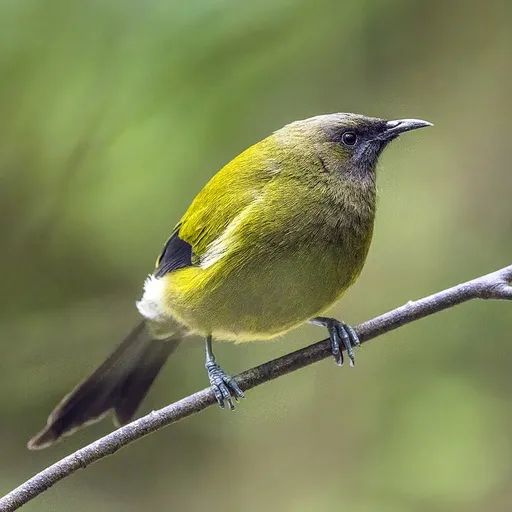
New Zealand Bellbird
Anthornis melanura
Least Concern
Listen
XC1059091 · craig wilson · Granity, Buller District, West Coast, New Zealand · CC BY 4.0
Overview
The New Zealand bellbird, also known as kōmako or makomako, is a medium-sized honeyeater endemic to New Zealand and the only living member of the genus Anthornis. It forms a significant component of the country's famed dawn chorus, a trait noted by early European settlers for its exquisite, bell-like quality.
Identification
- Males are olive-green with paler underparts, bluish-black wings and tail, and red irises, while females are duller, browner, have brown irises, and possess a narrow white stripe below the eye.
- The species measures 17–20 cm in length, with males weighing approximately 33 g and females 25 g.
- The bill is black and slightly curved downwards, with grey-black legs and brown claws.
- The ninth primary flight feather is notched, allowing the bird to produce specific whirring sounds in flight for courtship and territorial defence.
Habitat
The bellbird inhabits both native and exotic forests, scrublands, and urban areas such as parks and gardens, often thriving where a mix of podocarp-hardwood and beech forests is present. It ranges from sea level up to approximately 1,200 metres, including subalpine regions, and is found throughout the North and South Islands, Stewart Island, the Auckland Islands, and several satellite islands.
Diet
Bellbirds feed on nectar, fruit, honeydew, and insects, utilising a specialised brush-like tongue that is longitudinally grooved with fine hair-like structures at the tip to collect nectar from deep flowers.
Did you know?
Captain James Cook described the bird's song as 'like small bells most exquisitely tuned', and the species is regarded as taonga, a cultural or spiritual treasure, by the Māori, who traditionally valued it for both its meat and its melodious singing abilities.
Sources
- Wikipedia · CC BY-SA 4.0
- Wikidata · CC0 1.0