
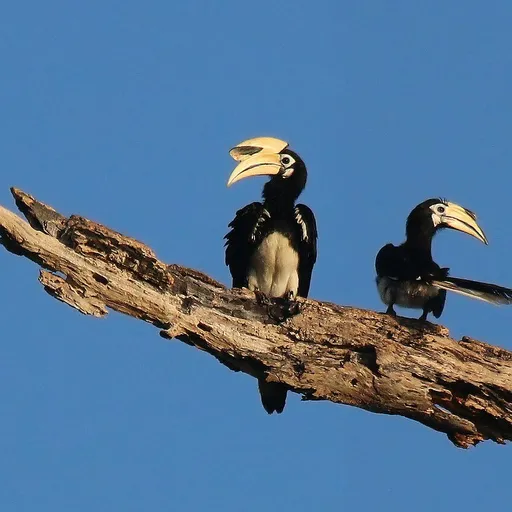
Oriental Pied Hornbill
Anthracoceros albirostris
Least Concern
Overview
The oriental pied hornbill, Anthracoceros albirostris, is a large canopy-dwelling bird found across the Indian subcontinent and Southeast Asia. It is considered one of the smallest and most common Asian hornbills, possessing the largest distribution within its genus.
Identification
- Head-to-tail length of 55–60 cm with a wingspan of 23–36 cm and a weight averaging 900 g.
- Black plumage on the head, neck, back, and upper breast with a slight green sheen, contrasting with white lower breast, abdomen, and thighs.
- Large yellow bill and casque in males, which feature bright red eyes; females have a smaller casque and grayish-brown eyes.
- Calls described as crowlike sounds, braying sounds, or harsh crackles and screeches.
Habitat
The species inhabits subtropical or tropical moist lowland forests, including dry and semi-evergreen forests, dry and moist deciduous forests, secondary forests, and plantations. Its range encompasses eastern and northern India, Nepal, Bangladesh, Bhutan, Tibet, Myanmar, Thailand, Laos, Cambodia, Vietnam, Peninsular Malaysia, Singapore, Indonesia, Brunei, and the Sunda shelf islands.
Diet
Predominantly frugivorous, feeding on wild fruits such as figs, melanoxylon berries, rambutans, palm fruit, papaya, and liana fruits. It also consumes large insects, small birds, reptiles, amphibians, fish, and bats, and has been observed preying on eggs and hatchlings from other nests.
Did you know?
The species is an important large seed disperser, promoting seedling recruitment by translocating seeds to open habitats, an ecological role few other bird species outside the hornbill family can perform due to gape width constraints.
Sources
- Wikipedia · CC BY-SA 4.0
- Wikidata · CC0 1.0