
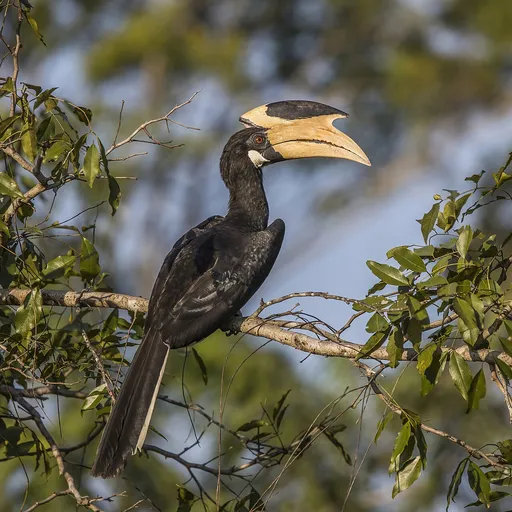
Malabar Pied Hornbill
Anthracoceros coronatus
Near Threatened
Overview
The Malabar pied hornbill (Anthracoceros coronatus), also known as the lesser pied hornbill, is a large, near-threatened species in the hornbill family found in the Old World. It is a common resident breeder in Sri Lanka and parts of India, where it inhabits low-altitude moist evergreen and tall deciduous forests. The species is monotypic and was first described in 1780.
Identification
- Large hornbill measuring 65 cm in length with a weight of approximately 1 kg.
- Mainly black plumage contrasted by a white belly, throat patch, tail sides, and the trailing edge of the wings.
- Yellow bill featuring a large, mainly black casque, which is absent in juveniles.
- Females possess white orbital skin, a feature that males lack.
Habitat
This bird is distributed across three main regions of the Indian sub-continent: Central and Eastern India, the Western Ghats, and Sri Lanka. It primarily inhabits low-altitude moist evergreen and tall deciduous forests, often near rivers, but also occurs in plantations, open forests, and home gardens. In Sri Lanka, it is found mainly in low country and dry zone forests.
Diet
Omnivorous, this species feeds on fruits, small mammals, birds, small reptiles, and insects, killing prey and swallowing it whole. Figs are a critical food source, making up 60% of the diet during the non-breeding season and up to 75% of fruits delivered to the nest during breeding. They also consume other fruits, including those of Strychnos nux-vomica, which are toxic to many vertebrates.
Did you know?
During the breeding season, the female lays eggs in a tree hole that is sealed off with a cement of mud, droppings, and fruit pulp, leaving only a narrow aperture for the male to feed her and the chicks. Once the chicks grow too large for the mother to remain inside the nest with them, she breaks out to rebuild the wall so both parents can feed the young.
Sources
- Wikipedia · CC BY-SA 4.0
- Wikidata · CC0 1.0