
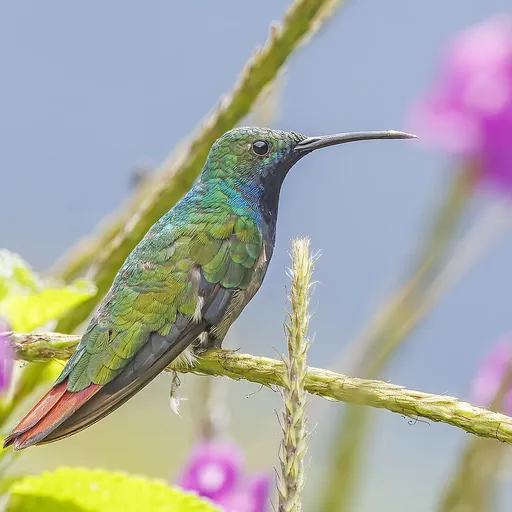
Black-throated Mango
Anthracothorax nigricollis
Least Concern
Overview
The black-throated mango (Anthracothorax nigricollis) is a small hummingbird in the subfamily Polytminae found across the lowland tropics of Central and South America. It ranges from Panama through most of mainland South America, excluding Chile, to Trinidad and Tobago.
Identification
- Size and Bill: Measures 10.2 to 14 cm in length and weighs 6 to 9 g, featuring a slightly decurved black bill.
- Male Plumage: Nominate males display a metallic bronze-green crown and upperparts with a black chin, throat, and central chest bordered by metallic bluish-green.
- Tail Markings: The innermost tail feathers are dusky bronze-green, while the outer four pairs are metallic magenta-rufous with dark blue edges and a violet sheen.
- Female Plumage: Females resemble males but lack the bronze tone on upperparts, featuring a thin, ragged black chin and throat stripe with a white border on otherwise green underparts.
Habitat
This species inhabits various semi-open to open lowland landscapes, including gallery forests, shade coffee and cacao plantations, forest edges, and urban parks or gardens. While generally a bird of the lowlands, it can reach elevations up to 2,000 m in eastern Brazil and 1,700 m in Colombia.
Diet
The bird feeds primarily on nectar from tall trees such as Erythrina and Tabebuia, as well as from vines and shrubs. Males defend feeding territories in trees and also hawk insects from high perches, occasionally glean them from foliage, or forage low down along roads and streams.
Did you know?
One recorded nest in Ecuador was situated in a tree inhabited by Pseudomyrmex stinging ants, which likely helped deter predators, although it remains unclear if the birds deliberately select such host trees.
Sources
- Wikipedia · CC BY-SA 4.0
- Wikidata · CC0 1.0