
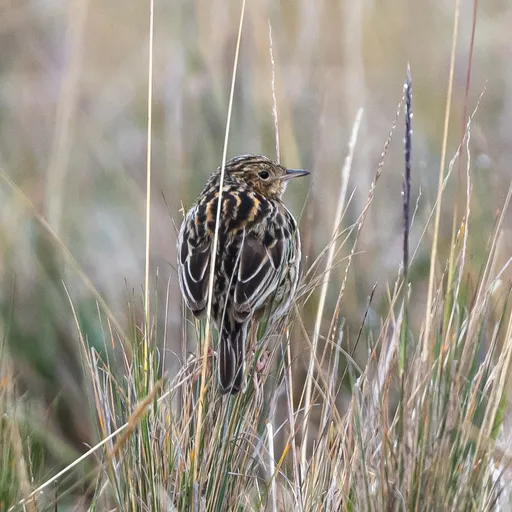
Paramo Pipit
Anthus bogotensis
Least Concern
Listen
XC242115 · Niels Krabbe · Pichincha: ne-slope Volcán Pichincha, Ecuador · CC BY-SA 4.0
Overview
The paramo pipit (Anthus bogotensis) is a small bird in the family Motacillidae, found across the Andes of South America. It inhabits open, treeless high-altitude landscapes, particularly páramo and puna grasslands, and is currently classified as Least Concern by the IUCN.
Identification
- Approximately 15 cm in length, with sexually identical plumage featuring a dusky to cinnamon-brown head and a buffy supercilium.
- Upperparts are dusky to cinnamon-brown with bold buff and blackish streaks, while underparts are darker buff with sparse dark streaks on the breast and flanks.
- Possesses a brown iris, a dusky upper bill, a pale lower mandible, and pinkish legs and feet.
- Vocalisation during flight consists of a long, nasal, wheezy buzz followed by high, chattery notes described as 'nyeeezzzzz, dziit-it, dziit-it, chit-it-it-it-it-it'.
Habitat
Found in Argentina, Bolivia, Colombia, Ecuador, Peru, and Venezuela, the species occupies open treeless environments such as páramo and puna grasslands, preferring flatter areas with short grasses, bunch grass, and bogs. It also occurs in nearby pastures and cultivated land, typically at elevations ranging between 2,200 and 4,400 m depending on the country and subspecies.
Diet
The paramo pipit feeds on insects and seeds, foraging on the ground among grass, shrubs, and other low vegetation. It forages singly, in pairs, or in small flocks, using walking and running movements to locate food.
Did you know?
Males perform a distinctive display flight involving a gliding descent to sing, while the nest is a cup constructed from grass and rootlets, lined with finer materials and placed on the ground within a grass clump.
Sources
- Wikipedia · CC BY-SA 4.0
- Wikidata · CC0 1.0