
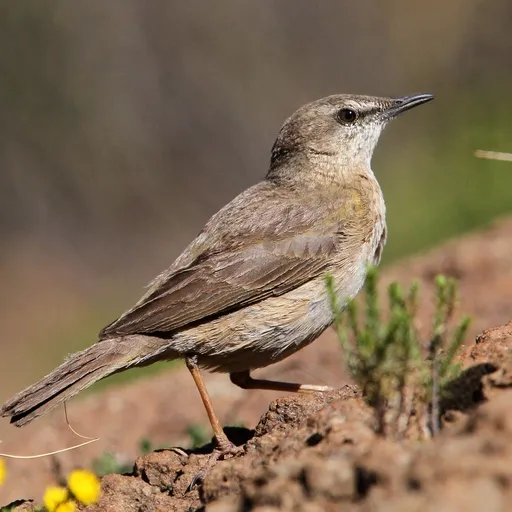
African Rock Pipit
Anthus crenatus
Near Threatened
Overview
The African rock pipit, also known as the yellow-tufted pipit (Anthus crenatus), is a small passerine bird native to South Africa and Lesotho. Classified as Near Threatened on the IUCN Red List, its population is estimated at between 3,300 and 8,900 mature individuals.
Identification
- Brown and gray plumage with distinctive yellow markings on the stomach and wings.
- A white-gray eyebrow helps distinguish the bird from other species.
- Size ranges from 17–18 cm with a mass of 29–32.5 g, featuring a dark brown beak and light brown legs.
- Produces a loud, high-pitched repeated 'whee-tsrreeu' call that stands out among other pipits.
Habitat
Found in the Afrotropical realm, specifically in mountain terrain across South Africa and Lesotho, with isolated populations in the Northern Cape Province. The bird inhabits high-altitude shrubland, grassland, and rocky hills, typically at elevations of 1,000 meters or higher.
Diet
The diet primarily consists of insects such as spiders and grasshoppers, though the bird occasionally feeds on seeds, other plants, and berries. It maintains a sedentary lifestyle and does not undergo seasonal migrations.
Did you know?
Newborn pipits are capable of taking flight in just twelve to fourteen days. Both parents participate in feeding the juveniles, with the female laying three to four eggs in a nest constructed from grass beneath a boulder or grass tuft.
Sources
- Wikipedia · CC BY-SA 4.0
- Wikidata · CC0 1.0