
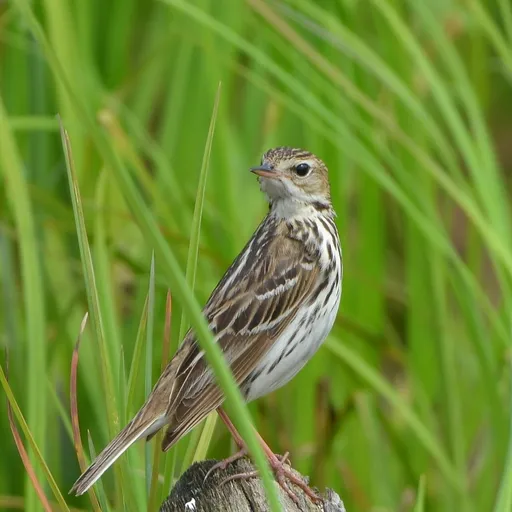
Pechora Pipit
Anthus gustavi
Least Concern
Overview
The Pechora pipit (Anthus gustavi) is a small passerine bird that breeds in the East Palearctic tundra and densely vegetated riverbank areas. It is a long-distance migrant that moves to Indonesia for the winter, and it was first described by Robert Swinhoe in 1863.
Identification
- Heavily streaked brown above with whitish mantle stripes, contrasting with a white belly and buff breast.
- Resembles the non-breeding red-throated pipit but has a heavier bill and whiter mantle stripes.
- Produces a distinctive electrical zip call, though it vocalises far less than most pipit species.
- Exhibits skulking behaviour, creeping in long grass and showing reluctance to fly even when disturbed.
Habitat
Breeds in damp tundra, open forest, marshland, and densely vegetated areas near river banks ranging from the Pechora River to the Chukchi Peninsula. The species also breeds in Kamchatka, the Commander Islands, and a disjunct population in northeastern China and southeastern Siberia. It winters in Indonesia and rarely appears in western Europe, with Fair Isle, Shetland, being a notable location for observing vagrants.
Diet
The species is insectivorous, similar to its close relatives.
Did you know?
The southern subspecies differs so markedly in ecology, morphology, and song that it may actually be a separate species, although genetic analysis has not yet been carried out to confirm this.
Sources
- Wikipedia · CC BY-SA 4.0
- Wikidata · CC0 1.0