
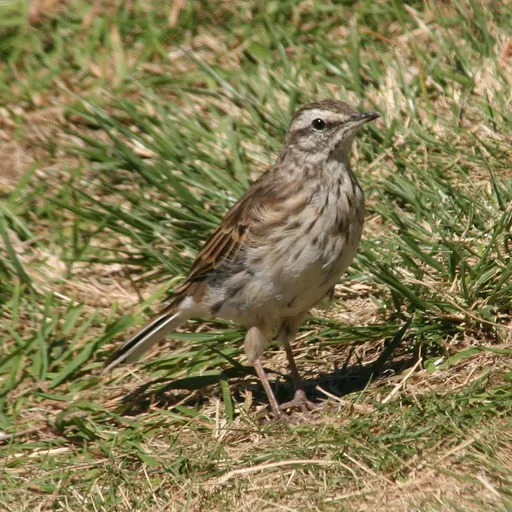
New Zealand Pipit
Anthus novaeseelandiae
Least Concern
Overview
The New Zealand pipit, Anthus novaeseelandiae, is a small passerine bird native to New Zealand and outlying islands, where it is also known by the Māori name pīhoihoi. As a member of the pipit genus Anthus in the family Motacillidae, it is well-adapted to life in open environments.
Identification
- Slender body measuring 16 to 19 cm in length and weighing approximately 40 grams
- Pale brown upperparts with dark streaks and pale underparts featuring streaked breasts
- Distinctive pale stripe over the eye, accompanied by dark malar and moustachial stripes
- Long, pinkish-brown legs and a slender, brownish bill
- Long tail with white outer feathers that is frequently wagged up and down
Habitat
It inhabits open country throughout New Zealand, including the North, South, and Stewart Islands, as well as the Chatham, Auckland, Campbell, and Antipodes Islands. Preferred environments include grassland, farmland, roadsides, dry river beds, sand dunes, and open woodland.
Diet
This species forages primarily on the ground for small invertebrates such as beetles, spiders, and insect larvae. It also supplements its diet with seeds, particularly those of grasses.
Did you know?
The species' holotype is a painting by Georg Forster, drawn from a specimen collected at Queen Charlotte Sound by Joseph Banks during James Cook's second voyage, and it is currently held at the Natural History Museum in London.
Sources
- Wikipedia · CC BY-SA 4.0
- Wikidata · CC0 1.0