
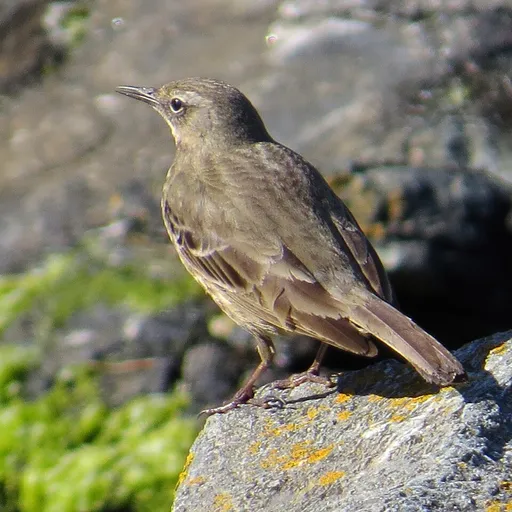
European Rock Pipit
Anthus petrosus
Least Concern
Listen
XC707268 · Sonothèque ADVL · Roz-sur-Couesnon, Ille-et-Vilaine, Bretagne, France · CC0 1.0
Overview
The European rock pipit (Anthus petrosus) is a small passerine bird that breeds on rocky coasts in western Europe. It is a territorial species, with the nominate subspecies being resident year-round and the Fennoscandian subspecies being migratory. The species is currently classified as least concern by the IUCN due to its large and stable population.
Identification
- 16.5–17 cm in length with smoky-olive upperparts streaked with darker brown and buff underparts marked with poorly defined brown streaks.
- Dark brown or blackish legs, bill, and iris, accompanied by a pale eye-ring; sexes are alike in appearance.
- Distinctive dark, rather than white, outer tail feathers distinguish it from similar species such as the meadow pipit.
- Song consists of a sequence of about twenty tinkling cheepa notes followed by rising thin gee calls and a short trill.
Habitat
Almost entirely coastal, frequenting rocky areas typically below 100 metres, although on St Kilda it breeds at up to 400 metres. The breeding range covers temperate and Arctic Europe on western and Baltic Sea coasts, with a very small number sometimes nesting in Iceland. While it avoids very exposed situations, it is not troubled by wind or rain and may occur further inland in winter or on migration.
Diet
Feeds mainly on invertebrates such as snails, worms, small crustaceans, flies, and beetles, picking most prey off rocks or from shallow water. It occasionally catches insects in flight and may scavenge human food litter during hard weather. It ventures into shallow water to follow retreating waves and exploits human activity that exposes prey hiding under stones.
Did you know?
Territorial males will sometimes enter an adjacent territory to assist the resident in repelling an intruder, a cooperative behaviour that requires distinguishing the resident from the intruder and is only otherwise known from the African fiddler crab.
Sources
- Wikipedia · CC BY-SA 4.0
- Wikidata · CC0 1.0