
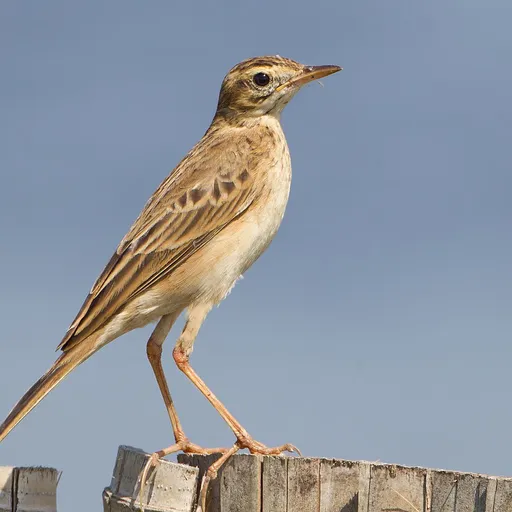
Richard's Pipit
Anthus richardi
Least Concern
Listen
XC943898 · Sonothèque ADVL · Vains, Manche, Normandie, France · CC0 1.0
Overview
Richard's pipit (Anthus richardi) is a medium-sized passerine bird that breeds in open grasslands across the East Palearctic. It is a long-distance migrant that moves to open lowlands in the Indian subcontinent and Southeast Asia for the winter, though it is a rare but regular vagrant to western Europe.
Identification
- A large, slender pipit measuring 17–20 cm in length, often standing very upright with long yellow-brown legs and a long tail with white outer-feathers.
- Unremarkable on the ground, appearing mainly brown above with dark streaks on the upperparts and breast, and pale, plain below.
- Distinctive facial markings include pale lores and supercilium contrasting with a dark eyestripe, moustachial stripe, and malar stripe, along with two wingbars formed by pale tips to the wing-coverts.
- Possesses a strong, undulating flight and produces an explosive "shreep" call reminiscent of a house sparrow, accompanied by a monotonous, buzzy song delivered in an undulating flight.
Habitat
This species inhabits open country, particularly flat lowland areas such as grassland, steppe, and cultivated land, with a preference for more fertile, moist habitats. It breeds in southern Siberia, Mongolia, parts of Central Asia, and northern, central, and eastern China, migrating to the Indian subcontinent and Southeast Asia. In Europe, it is most often recorded on headlands and islands as a scarce passage migrant.
Diet
As an insectivore, Richard's pipit mainly feeds on the ground while also making short flights to catch flying insects. It supplements its diet with a small amount of seeds.
Did you know?
The species is named after Charles Richard, a French naturalist who served as director of postal services at Lunéville, linking this bird of open grasslands to the history of communication networks.
Sources
- Wikipedia · CC BY-SA 4.0
- Wikidata · CC0 1.0