
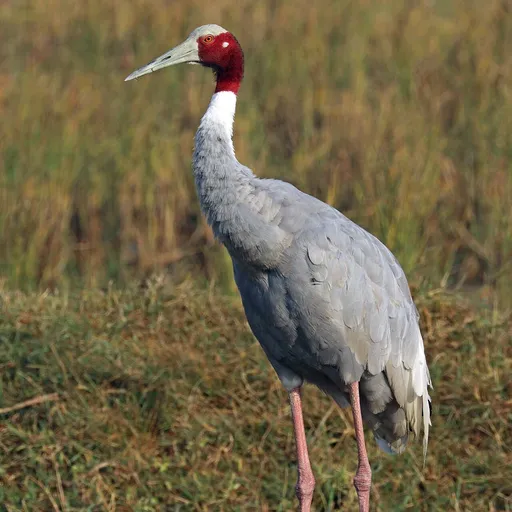
Sarus Crane
Antigone antigone
Overview
The sarus crane (Antigone antigone) is a large, nonmigratory crane found in parts of the Indian subcontinent, Southeast Asia, and northern Australia. It is the tallest of all flying birds, standing up to 1.8 m high, and is a conspicuous presence in open wetlands, seasonally flooded forests, and eucalyptus woodlands.
Identification
- Overall grey body with a bare red head and upper neck, often displaying a narrow black bristly area around the head.
- Very large size, with Indian populations reaching up to 1.8 m in height and a wingspan of 220–250 cm.
- Long, greenish-grey, pointed bill and long, pink legs that trail behind in flight.
- Grey ear covert patch and orange-red irises; juveniles have a yellowish-billed base and a fully feathered brown-grey head.
Habitat
Historically widespread across the lowlands of India, the species now primarily occupies agricultural lands, paddy fields, and wetlands in the Indian subcontinent, with populations in Southeast Asia's seasonally flooded Dipterocarpus forests and northern Australia's Eucalyptus-dominated woodlands. Its global range has shrunk, with the stronghold and largest known population located in India, particularly in Uttar Pradesh where it lives in close proximity to humans.
Diet
The sarus crane forages on marshes and shallow wetlands for a varied diet that includes roots, tubers, insects, crustaceans, and small vertebrate prey.
Did you know?
In India, the species is revered as a symbol of marital fidelity, with a traditional belief that the birds mate for life and will starve to death upon the loss of their mates.