
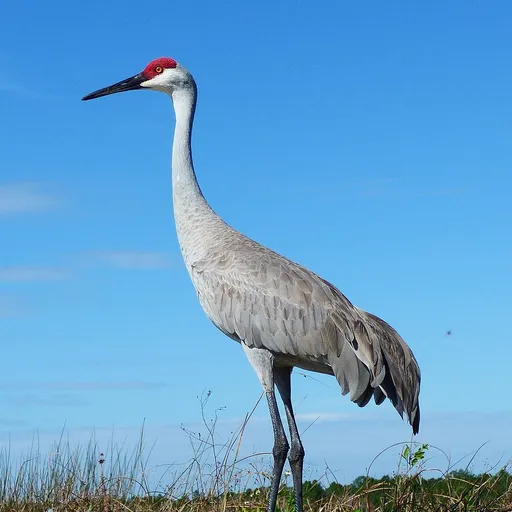
Sandhill Crane
Antigone canadensis
Listen
XC991765 · Doug Hynes · Landing Lake, Churchill, MB, Canada · CC BY-SA 4.0
Overview
The Antigone canadensis is a large crane species native to North America and extreme northeastern Siberia, commonly found on the edges of bodies of water. With populations reaching up to 450,000 in certain stopover areas, it is the most plentiful extant crane in the continent.
Identification
- Adults appear grey overall, though breeding plumage may look nearly ochre due to wear and staining.
- Characteristic red foreheads and white cheeks are visible; juveniles lack the red foreheads, helping distinguish them from adults.
- They possess long, dark, pointed bills, and in flight their long necks remain straight with trailing legs.
- Their loud, trumpeting calls can be heard from long distances, often in synchronized duets between mated pairs.
Habitat
Sandhill cranes occupy pastures, open prairies, and freshwater wetlands, with populations spread across North America and northeastern Siberia.
A 2025 study indicates a genetic divide between inland and coastal populations, which show consistent morphological and behavioural differences.
Diet
They are mainly herbivorous, foraging for seeds in shallow wetlands and upland areas.
Depending on availability, their diet may also include berries, small mammals, insects, snails, reptiles, and amphibians.
Did you know?
Sandhill cranes can kill predators such as coyotes by piercing their skulls with their sharp beaks.