
Mexican Whip-poor-will
Antrostomus arizonae
Least Concern
Overview
The Mexican whip-poor-will, Antrostomus arizonae, is a medium-sized nightjar found in the southwestern United States, Mexico, and northern Central America. It was separated from the eastern whip-poor-will in 2010 based on genetic, morphological, and vocal differences.
Identification
- Medium-sized bird measuring 23 to 24 cm in length with a weight of 45 to 50 g.
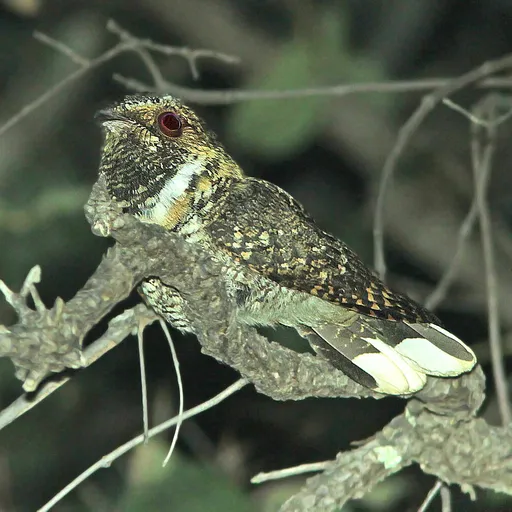
- Upperparts are grayish brown with blackish brown streaks and wide stripes on the crown; wings feature brown plumage with tawny and buff spots.
- Throat and breast are blackish separated by a thin white band on the lower throat, while the belly is buff with brown bars.
- Males have broad white tips on the outermost three pairs of tail feathers, which are narrower and buffy in females.
- Song is a lower-pitched and 'lazier' version of the onomatopoeic 'whip-poor-will' call, accompanied by quirt, queerp, or growl sounds.
Habitat
The species occupies semi-arid to moist landscapes with oaks and pines at mid- to mid-upper elevations in the north, while more southerly resident subspecies inhabit forest and woodland environments. Its range extends from southeastern California and southwestern Texas through Mexico into northern Central America, including Honduras and El Salvador.
Diet
Foraging behaviour is assumed to resemble that of the eastern whip-poor-will, involving sallying from a tree perch and less frequently from the ground. The diet consists primarily of insects, with moths and beetles being the dominant prey items.
Did you know?
The species is classified as Least Concern on the IUCN Red List with an estimated 320,000 mature individuals, yet its population is believed to be decreasing despite no immediate threats being identified. Additionally, both sexes possess a brood patch, suggesting that both partners participate in tending the two eggs laid directly on leaf litter without a conventional nest.
Sources
- Wikipedia · CC BY-SA 4.0
- Wikidata · CC0 1.0