
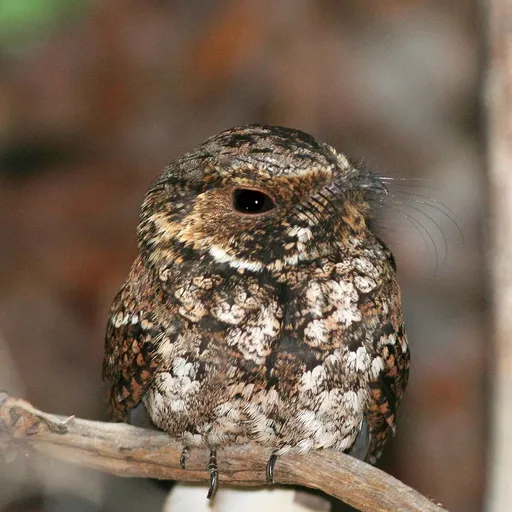
Puerto Rican Nightjar
Antrostomus noctitherus
Vulnerable
Overview
The Puerto Rican nightjar, also known as the Puerto Rican whip-poor-will or guabairo, is a vulnerable bird species in the nightjar family. It inhabits localized areas of southwestern Puerto Rico and was considered extinct until living specimens were observed in the wild in 1961.
Identification
- Small bird measuring 22–23 cm in length and weighing 39–41 g.
- Mottled black, brown and grey plumage providing camouflage on the ground, with white spots on the lower tail visible in flight.
- Males feature a black throat with a thin white horizontal line, while females display buff rather than white colouration.
- Large, dark black eyes, a short grey bill, and stiff bristles around the beak; song consists of rapid 'whip' notes.
Habitat
Presently found mostly in closed-canopy dry forests on limestone soils with abundant leaf litter and an open understory, with lower densities in open scrubby forests. Populations are confirmed in three locations in the southwest of the island: Susúa State Forest, Guánica Dry Forest and Guayanilla Hills. It historically occurred in moist limestone and coastal forests in northern Puerto Rico.
Diet
Feeds on beetles, moths and other insects caught in flight. Nests on the ground under closed canopies, requiring an abundant leaf layer to hold the eggs, with peak nesting activity from April to June.
Did you know?
The species was originally considered already extinct when it was first correctly identified in 1916 from bones found in a cave. The chicks start to fly at approximately 14 days after hatching.
Sources
- Wikipedia · CC BY-SA 4.0
- Wikidata · CC0 1.0