
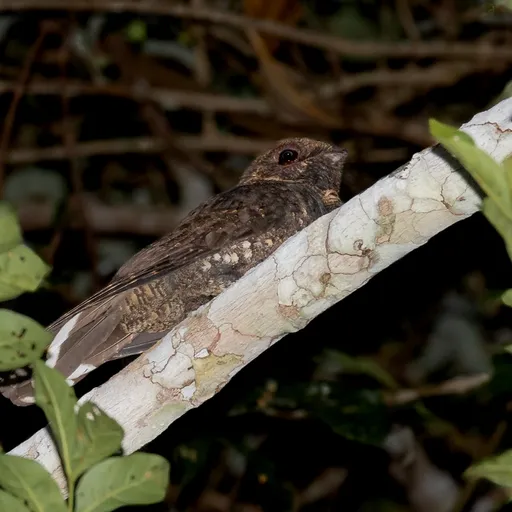
Silky-tailed Nightjar
Antrostomus sericocaudatus
Least Concern
Overview
The silky-tailed nightjar, Antrostomus sericocaudatus, is a species of nightjar in the family Caprimulgidae. It is currently classified as Least Concern by the IUCN, though its population is believed to be decreasing.
Identification
- Adult males possess light grey-brown, vermiculated plumage with a strong blackish streak on the top of the head and nape.
- The hind-neck features narrow rufous-tawny half-collar plumage, while the mantle, back, and rump are blackish-brown with irregular patterns of buff and cinnamon.
- The breast is blackish-brown with short narrow bars of cinnamon, and the belly is blackish-brown with blotches and irregular narrow bars of buff.
- Two subspecies have distinct songs: A. s. sericocaudatus sings a short tonal gliss, while A. s. mengeli produces an almost mournful, undulating cry.
Habitat
The species inhabits subtropical or tropical moist lowland forests, including the interior and edges of secondary forest, mature tropical forest, and terra firme forest. Its range spans Brazil, Argentina, Bolivia, Paraguay, and Peru, with the nominate subspecies found in the Atlantic Forest region and the mengeli subspecies in eastern Peru and northwestern Bolivia.
Diet
Nightjars consume a variety of insects, with young being fed by parents through regurgitation. Nestlings also forage for ground insects around the nest site or pick up small soil granules to aid in digestion.
Did you know?
To protect their nests from predators, adult nightjars commonly employ injury-feigning to lure threats away, often while repositioning themselves to remain highly obscure while the eggs are visible.
Sources
- Wikipedia · CC BY-SA 4.0
- Wikidata · CC0 1.0