
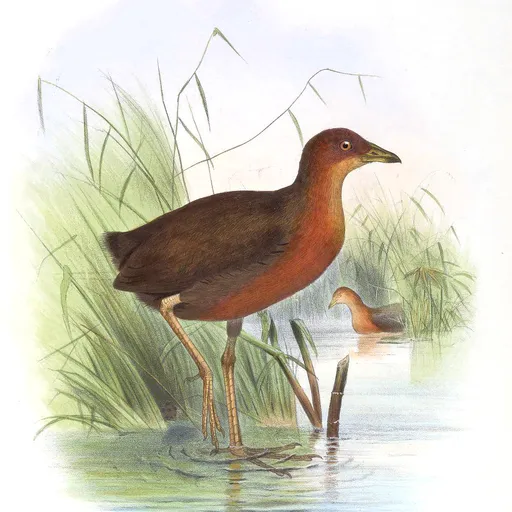
Chestnut-headed Crake
Anurolimnas castaneiceps
Overview
The chestnut-headed crake (Anurolimnas castaneiceps) is a species of bird in the family Rallidae and the sole member of its genus. It is a year-round resident found across parts of South America, including Bolivia, Brazil, Colombia, Ecuador, and Peru.
Identification
- Measures 19 to 21.5 cm in length with a bright rufous forecrown, head sides, neck, and breast in adults.
- Features a mostly black maxilla that is greenish below the nostrils and a greenish mandible with a black tip.
- The nominate subspecies has dull brown or olivaceous legs and feet, whereas the A. c. coccineipes subspecies has red legs and feet.
- Produces a loud, melodic song consisting of a long series of tri- or bisyllabic whistles described as "wee-hoohoo wee-hoohoo wee-hoohoo".
Habitat
The species inhabits humid landscapes with dense understories, particularly secondary forests and overgrown agricultural plots in tropical evergreen forests. It is notably able to be found far from water, a trait distinguishing it from most other members of its family. Altitude ranges vary by location, occurring up to 1,500 m in Colombia and generally below 1,000 m in Ecuador.
Diet
The crake forages by probing debris and rotten wood, and by flicking aside leaves while walking on the ground. It also pecks at similar substrates above the ground by stretching up. Although its specific diet has not been documented, it is assumed to consist of invertebrates and seeds.
Did you know?
The chestnut-headed crake benefits from low levels of human disturbance, taking advantage of edge habitats around small garden plots. Its genus name, Anurolimnas, combines the Greek negative prefix an- with oura (meaning "tail") and limnas (meaning "rail").