
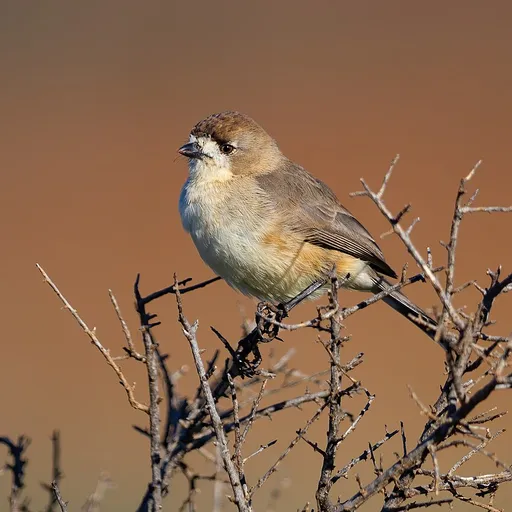
Southern Whiteface
Aphelocephala leucopsis
Vulnerable
Overview
The southern whiteface (Aphelocephala leucopsis) is a small passerine found in arid regions across most of the southern half of the Australian continent, excluding Tasmania. Superficially finch-like in appearance, this insectivorous bird is relatively common throughout most of its range, however, overall populations appear to be in decline.
Identification
- Stocky, thornbill-like build with a brown dorsum, white belly, dark brown wings and a black tail with a narrow white tip.
- Approximately 11.5 cm in length, featuring a cream-coloured eye, grey legs, and a stubby dark grey bill.
- Distinguished by characteristic facial markings: a white band across the forehead with a darker streak along the top edge; juveniles lack the black rear band on the face.
- Calls include a rapid, noisy twittering tchip-tchip-chiptchipt-chipt-chip or tzip-tzip-tziptzip, and a harsher kzzurrk, kzzurrk-kzzurrk in alarm.
Habitat
Endemic to Australia, the species typically inhabits arid open woodlands with a shrubby or grassy understory, as well as grass plains throughout much of the continent's south. It is not present in Tasmania or coastal areas of the mainland, preferring Acacia woodlands, particularly those dominated by mulga and drought-resistant chenopod shrub species, including saltbush and bluebush. Although considered sedentary, individuals may move into wetter areas outside their normal range during drought years.
Diet
Feeds primarily on arthropods, particularly insects and arachnids, but also takes seeds and leaves. Forages almost exclusively on the ground, favouring habitats with low tree densities, a herb understory, and without large amounts of litter cover, obtaining prey exclusively by gleaning. Typically forages in small groups of 2-8 individuals, though may congregate in larger flocks of up to 70 during the non-breeding season, often participating in mixed-species feeding flocks.
Did you know?
The genus name Aphelocephala was adopted after the birds were originally classified as Xerophila, but a group of molluscs had already been ascribed that name. The marked difference in the size and shape of the whiteface's beak compared with that of its closest relative, the scrubtit, has been attributed to an increased dietary intake of seeds, requiring a more robust bill.
Sources
- Wikipedia · CC BY-SA 4.0
- Wikidata · CC0 1.0