
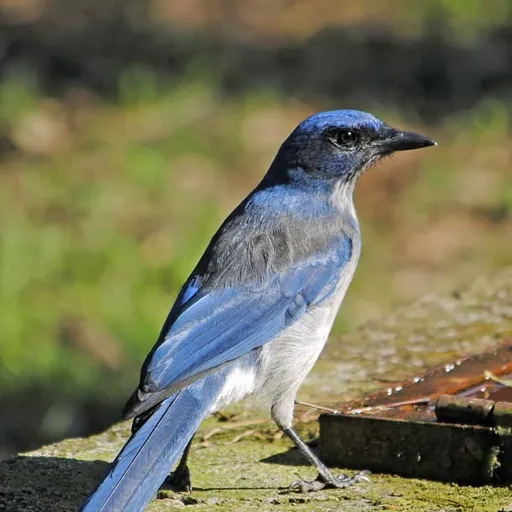
Transvolcanic Jay
Aphelocoma ultramarina
Least Concern
Overview
The Transvolcanic jay (Aphelocoma ultramarina) is a bird species in the family Corvidae that is endemic to Mexico. It was previously classified as part of the Mexican jay but was separated in 2011 due to significant genetic divergence and morphological differences. The species is currently assessed as Least Concern by the IUCN, though its population is believed to be decreasing.
Identification
- Adults measure 28 to 32 cm in length and feature a dark bluish head with black lores, a pale grayish throat, and bluish purple upperparts.
- Underparts are dingy grayish white, lightest on the undertail coverts, while the bill is heavy, pointed, and black, matching the black legs and feet.
- The vocalisation resembles that of the Mexican jay, characterised as an upslurred grating call note repeated singly, in doubles, or in series, with the grating decreasing towards the end of each note.
Habitat
Found in the Transvolcanic Belt of south-central Mexico, the species inhabits montane pine and pine-oak forest in the subtropical zone at elevations between approximately 900 and 3,400 m. The nominate subspecies ranges from southeastern Jalisco and northwestern Michoacán east to Veracruz, while the colimae subspecies is restricted to Jalisco and northeastern Colima.
Diet
Diet consists primarily of seeds from pines and oaks, supplemented likely by fruits, invertebrates, and small vertebrates. The birds forage on the ground, in shrubs, and in trees, maintaining a territory and caching and recovering food throughout the year.
Did you know?
The colimae subspecies faces a higher risk than the rest of the species because its small range is undergoing extensive habitat clearance for agriculture and timber.
Sources
- Wikipedia · CC BY-SA 4.0
- Wikidata · CC0 1.0