
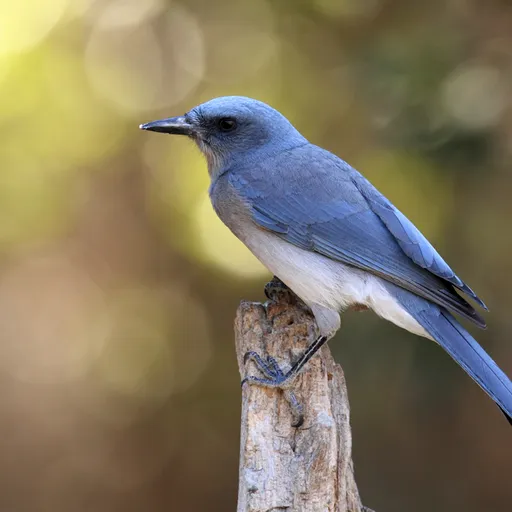
Mexican Jay
Aphelocoma wollweberi
Least Concern
Overview
The Mexican jay (Aphelocoma wollweberi) is a medium-sized passerine bird native to the mountainous regions of Mexico and parts of the southwestern United States. Once considered a single species, it was split from the Transvolcanic jay in 2011 based on genetic and phenotypic differences. It is classified as a species of Least Concern by the IUCN due to its wide range and common status.
Identification
- Medium-large jay with blue upper parts and pale gray underparts.
- Distinguished from the Woodhouse's scrub-jay by its unstreaked throat and breast, whereas the scrub-jay has streaked markings.
- Features a black bill and black legs with brown irises; juveniles may have a pink or pale bill base that darkens with age.
- Mantle coloration contrasts less with the head and wings than in the Woodhouse's scrub-jay.
Habitat
Native to the Sierra Madre Oriental, Sierra Madre Occidental, and Central Plateau of Mexico, as well as eastern Arizona, western New Mexico, and western Texas in the United States. Its preferred habitat is montane pine-oak forest.
Diet
Diet consists largely of acorns and pine nuts, which are stored in autumn, but the bird is omnivorous in all seasons. It also consumes a wide variety of plant matter, invertebrates, small amphibians, reptiles, and bird eggs or nestlings.
Did you know?
The species practises a cooperative breeding system where the dominant pair is assisted by helpers, usually immature offspring from previous years or unrelated flock members. In some populations, the egg color varies significantly with elevation, with plain, speckled, and even white eggs observed in a single study area.
Sources
- Wikipedia · CC BY-SA 4.0
- Wikidata · CC0 1.0